
Ask ten travelers about money in Laos and you will get ten versions of the same story: a wallet so stuffed with kip it will not fold, an ATM that dispensed less than expected and charged more than hoped, and then, surprisingly, a noodle vendor in Vientiane who pointed at a laminated QR code when they tried to hand over a brick of banknotes. Laos is further along the QR road than its reputation suggests. Here are the questions people actually search before they go, answered straight.
Is Laos still a cash-only country?
No, and that answer surprises people. In Vientiane and Luang Prabang, QR payments through the national LAO QR standard have spread fast. Cafes, minimarts, guesthouses, pharmacies, tour desks, and a growing share of market stalls display a QR code at the counter, and locals pay by scanning it with their phones. The smaller the town and the further from the Mekong corridor you get, the more cash matters, but in the two cities most visitors spend their time in, a phone is now a legitimate primary way to pay in Laos.
What exactly is LAO QR?
LAO QR is the standardized QR code format used across Lao banks and payment apps, the local equivalent of PromptPay in Thailand or KHQR in Cambodia. One printed code at the till works for customers of different Lao banks, which is why you see the same style of sticker everywhere from a Vientiane coffee shop to a sticky rice stall. The catch for visitors has always been that the apps reading those codes are built for people with Lao bank accounts. That is the gap Moreta Pay closes: you scan the same LAO QR code the locals scan, and your wallet handles the conversion from your home currency behind the scenes.
Why does everyone complain about kip?
Because of the denominations. The kip comes in large numbers, so even a modest day of spending means carrying a thick stack of notes. A round of coffees, a market lunch, and a tuk-tuk ride can each involve counting out multiple bills while a queue forms behind you. There is nothing wrong with kip itself, but physically managing it is a chore. Every payment you move to QR is one less wad to count, one less pocket bulging, and one less moment of squinting at zeros in dim light.
What is the problem with ATMs in Laos?
Two things, and they compound each other. Withdrawal limits per transaction are low, and fees per withdrawal are high. So to cover a week of spending in cash, you end up making several separate withdrawals, paying the fee each time, and possibly paying your home bank's foreign ATM fee on top. Travelers who arrive planning to run on cash often find the ATM routine is the single most annoying money task of their trip. The practical fix is to invert the plan: pay by QR wherever LAO QR is accepted, and withdraw cash only for the genuinely cash-only situations.
Can I use LAO QR without a Lao bank account?
Yes. You do not need a local account, a local card, or any in-country paperwork. With Moreta Pay you top up a wallet from your own bank at home (US bank connection, ACH, SEPA, UK Faster Payments, or Canadian e-Transfer) or from an international credit or debit card, in your own currency. When a vendor shows you their LAO QR code, you scan it, check the amount, the exchange rate, and the merchant name on screen, then confirm. The merchant is paid instantly in kip, and you never touched a banknote. If you fund by bank transfer, it is worth reading up on how early to send a top-up before you need it, because landing in Vientiane with an empty wallet defeats the purpose.
Where in Vientiane and Luang Prabang can I actually pay by QR?
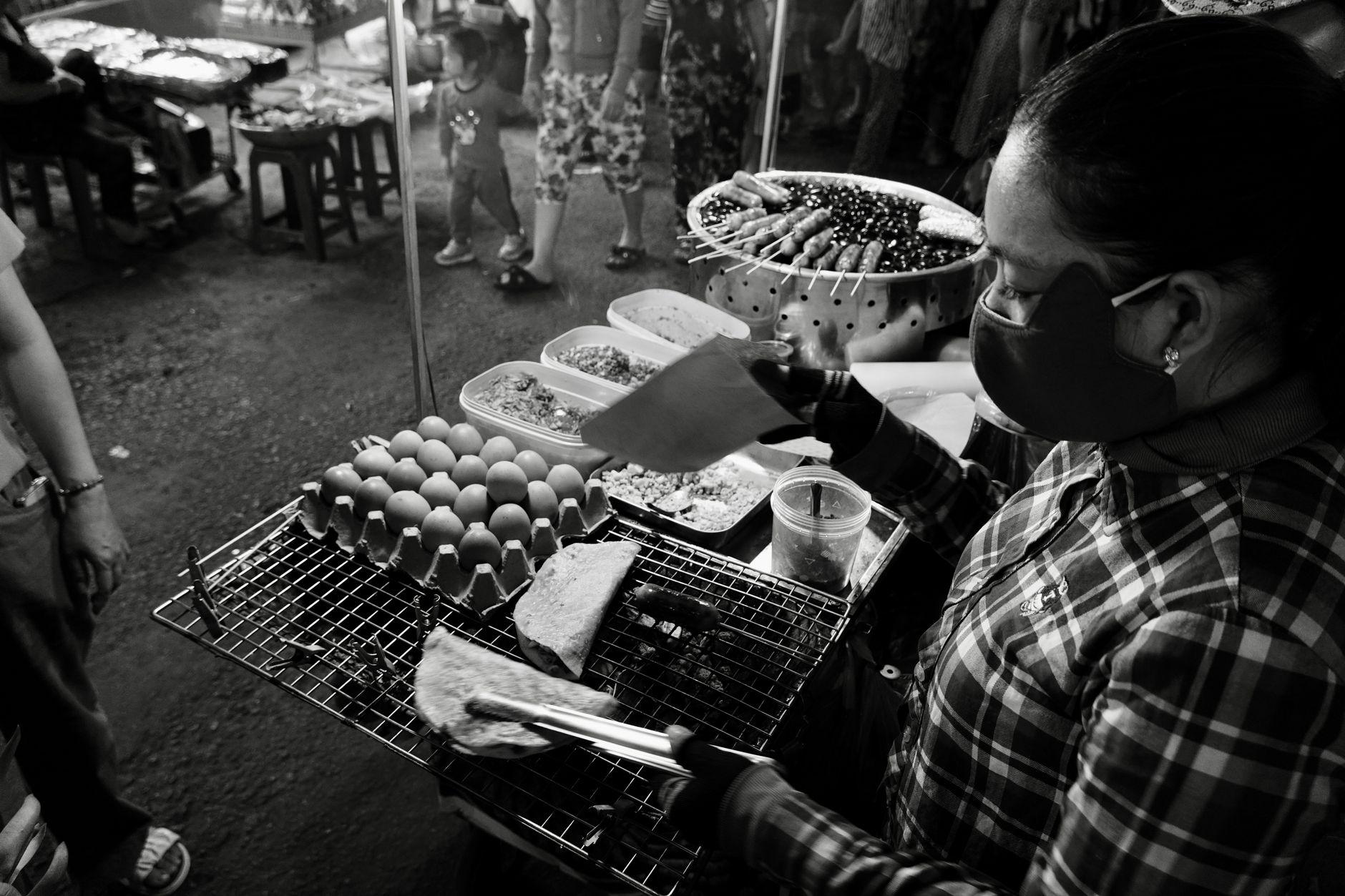
More places than you would guess. In Vientiane: the espresso bars and brunch spots along the riverside and around Nam Phou, minimarts, pharmacies, many restaurants, and a decent share of the stalls at the night market by the Mekong. In Luang Prabang: cafes on the peninsula, bakeries, guesthouses, tour agencies booking Kuang Si Falls trips, and increasingly the vendors at the famous night market, where a QR sticker taped to a bamboo pole is no longer a novelty. The pattern is simple: if the business has a till or a regular pitch, there is a fair chance there is a code. If it is a roadside grill with no fixed spot, assume cash.
How much cash should I still carry?
Keep a modest reserve for the gaps: rural stops on a slow boat journey, small village shops, temple donations, the occasional songthaew driver who shrugs at your phone. A sensible rhythm is one planned withdrawal that covers your cash-only needs for several days, rather than daily ATM visits. The point is not zero cash, it is making cash the exception so the low limits and high fees stop dictating your schedule.
Does QR work for bookings and online payments too?
Often, yes. If you are booking rooms or transport on platforms like Trip.com or Agoda and a QR payment option appears at checkout, Moreta Pay can handle that the same way it handles a market stall, scan, review, confirm. For longer stays, that extends to paying recurring local costs without ever routing through a Lao bank account.
Is this the same setup as Thailand or Cambodia?
Functionally, yes, which is good news if Laos is one stop on a longer loop. The QR standard changes at each border (PromptPay, then LAO QR, then KHQR), but your wallet and your habits do not. If Cambodia is next on your route, the logic in our guide to funding KHQR payments without a local account carries over almost exactly.
What should I do before I land in Laos?
Three things. First, set up and fund your wallet before departure so there is no waiting around on arrival. Second, make sure you will have data, whether by eSIM, local SIM, or roaming, since scanning a code requires a connection. Third, adjust your expectations: you are not arriving in a cash-only backwater, you are arriving in a country where the locals ahead of you in the coffee queue are paying with their phones. Join them. Set up Moreta Pay at moretapay.com before your flight and let the kip bricks stay at the bank.