
Eating Through Vietnam's Night Markets
Nobody warned me about the snails.
I was standing in the middle of Saigon's Ho Thi Ky Market on a Tuesday night, shoulder to shoulder with about a hundred locals and exactly zero tourists, holding a plastic bowl of ốc hương — sweet sea snails swimming in a tamarind and lemongrass broth. The woman who sold them to me had pointed at her VietQR code, I'd scanned it with Moreta, paid ₫45,000, and now here I was. Picking snails out of their shells with a safety pin. Absolutely hooked.
Vietnam's night markets don't get the same travel blog attention as Thailand's or Taiwan's. That's a mistake. After spending three weeks eating my way from Hanoi to Ho Chi Minh City — hitting every night market, walking street, and sidewalk stall I could find — I'm convinced that Vietnam has the best after-dark food scene in all of Southeast Asia. And it's shockingly easy to navigate as a foreigner, even without cash.
Here's what I found, what I ate, and what I wish someone had told me before I went.
Hanoi: Where the Night Market Is Really a Street Food Crawl
The Hanoi Night Market runs Friday through Sunday along Hàng Đào Street in the Old Quarter. You'll read about it in every guidebook. What the guidebooks don't tell you is that the market itself — the actual stalls selling t-shirts and phone cases — is the least interesting part.
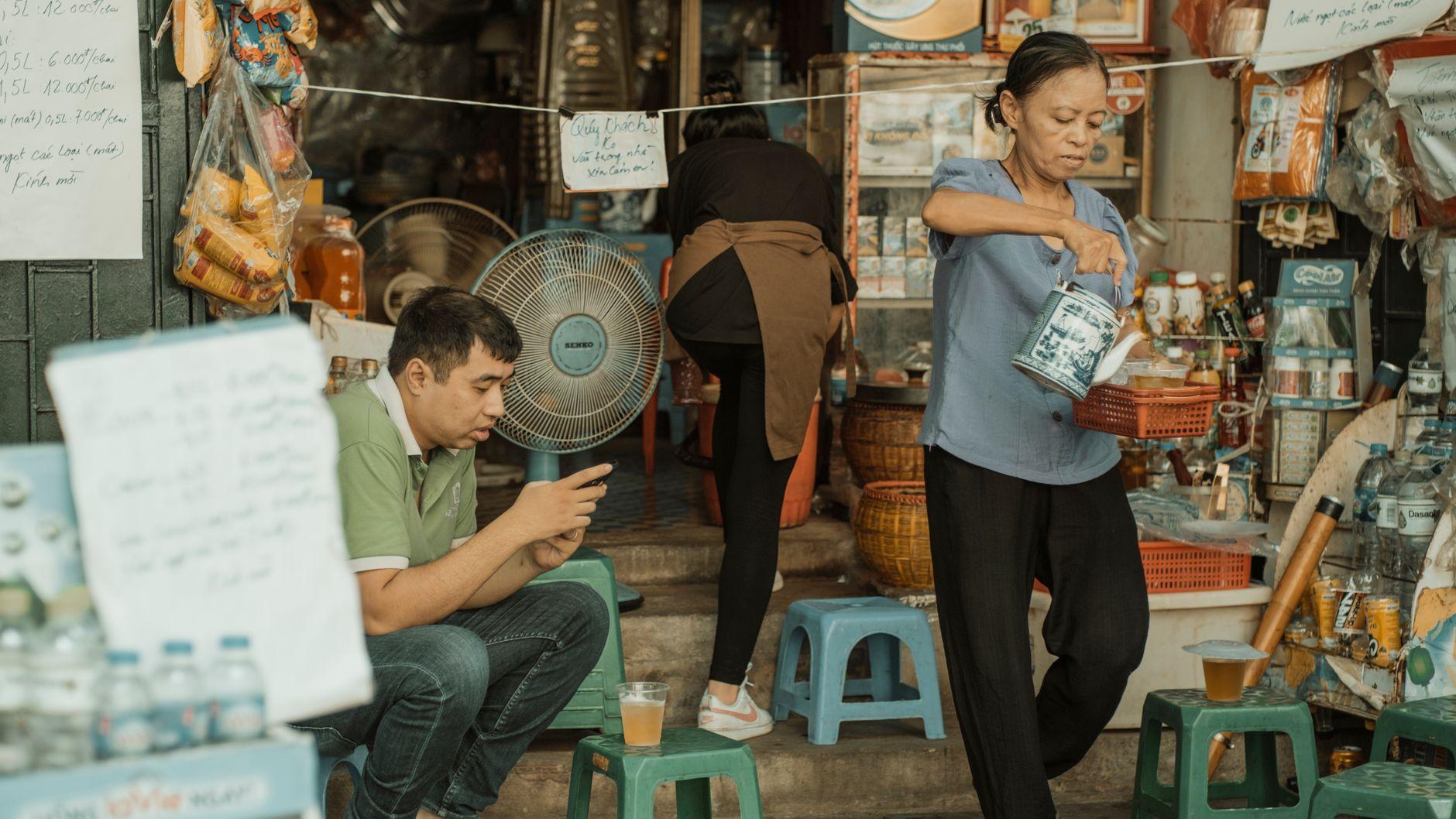
The real action is on the side streets. Duck off the main drag onto Hàng Buồm or Tạ Hiện and suddenly you're in the thick of it. Tiny plastic stools. Metal trays piled with bún chả. The hiss of bánh tráng nướng — sometimes called "Vietnamese pizza" — crisping on charcoal grills. Old women ladling bowls of cháo sườn (pork rib porridge) from steel pots the size of a toddler.
I ate at maybe fifteen different stalls over two weekends in Hanoi. Most of them had QR codes taped to a piece of cardboard or laminated and stuck to the side of a cart. The VietQR system in Hanoi has gotten so widespread that even the lady roasting chestnuts on Lý Quốc Sư had one. I scanned, confirmed the amount, and she went back to her chestnuts without missing a beat.
A few tips if you're heading to the Old Quarter for food: go after 8 PM when the stalls are fully set up. Don't eat a big dinner beforehand — you want to graze. And budget around ₫150,000 to ₫250,000 (roughly $6 to $10) for a proper crawl. That's four or five dishes and a couple of bia hơi draft beers.
Hội An: Lanterns, Tourists, and the Best Cao Lầu You'll Ever Have
I almost skipped Hội An's night market because everyone told me it was touristy. They weren't wrong — the main stretch along Nguyễn Hoàng Street is packed with souvenir stalls and lantern shops. But writing it off entirely would've been a mistake.
The food section sits at the far end of the market, closer to the river. It's compact — maybe twenty or thirty stalls — but the quality is absurd. I had cao lầu (a pork and noodle dish you literally cannot get outside of Hội An because of the specific water used in the noodles), white rose dumplings, and a bowl of mì quảng that cost me ₫35,000 and made me reconsider every noodle soup I'd ever eaten before.
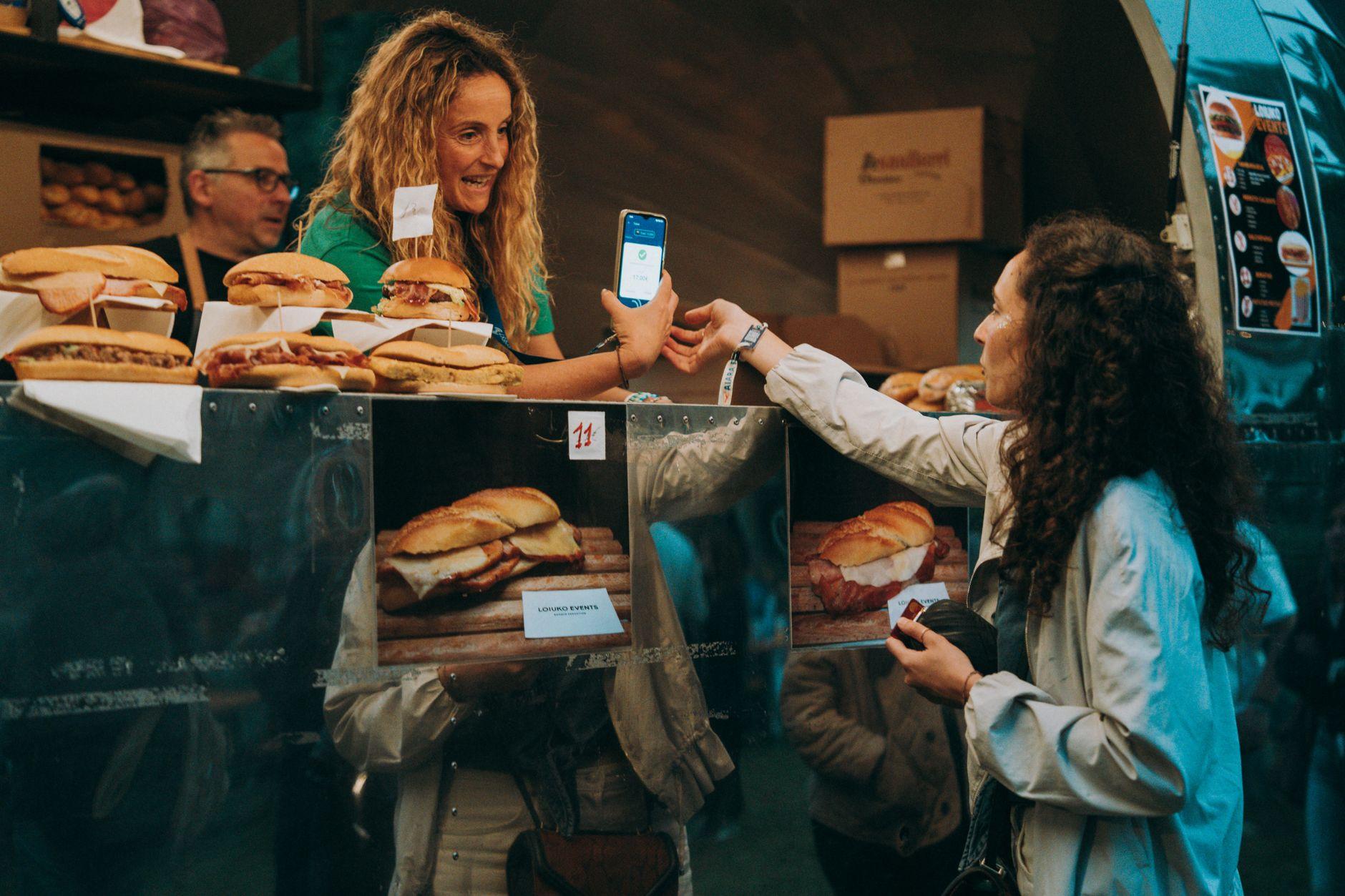
Most stalls here take QR payments. The vendors are used to foreigners, and a lot of them actually prefer the QR scan over handling cash because it's faster when lines get long. I paid for everything through Moreta Pay, showed the confirmation screen, and moved on. No arguing over change for a ₫500,000 note. No wondering if I'd been given the right amount back.
One thing worth noting: Hội An's night market opens daily, not just weekends. Get there around 5:30 PM if you want first pick of the food stalls before the crowds really settle in.
Da Nang: The Underrated Night Market City
Everyone flies into Da Nang and immediately heads to Hội An or the Marble Mountains. I did too, the first time. On my second pass, I stayed a couple of nights and stumbled into something great.
Sơn Trà Night Market sits near the Dragon Bridge and runs every evening. It's got a stronger local feel than Hội An — fewer tourists, more Vietnamese families eating dinner out. The seafood here is ridiculous. Grilled squid, steamed clams with lemongrass, garlic butter prawns the size of my hand. You pick what you want from an ice display, they weigh it, grill it, and bring it to your plastic table.
I had a full seafood spread — clams, prawns, squid, rice, and two Saigon beers — for about ₫320,000 total. That's roughly $13. The stall had a QR code on the table, and I paid the whole thing in one scan.
Da Nang also has Bạch Đằng Pedestrian Street along the Hàn River, which opened as a proper night walking area in 2024. It's more of a strolling and snacking vibe than a sit-down-and-eat situation. Bánh mì, grilled corn, coconut ice cream, and these incredible little bánh xèo (crispy turmeric crepes) cooked in tiny pans right in front of you. Perfect for an evening walk after hitting the beach.
Ho Chi Minh City: Where Night Markets Are a Lifestyle
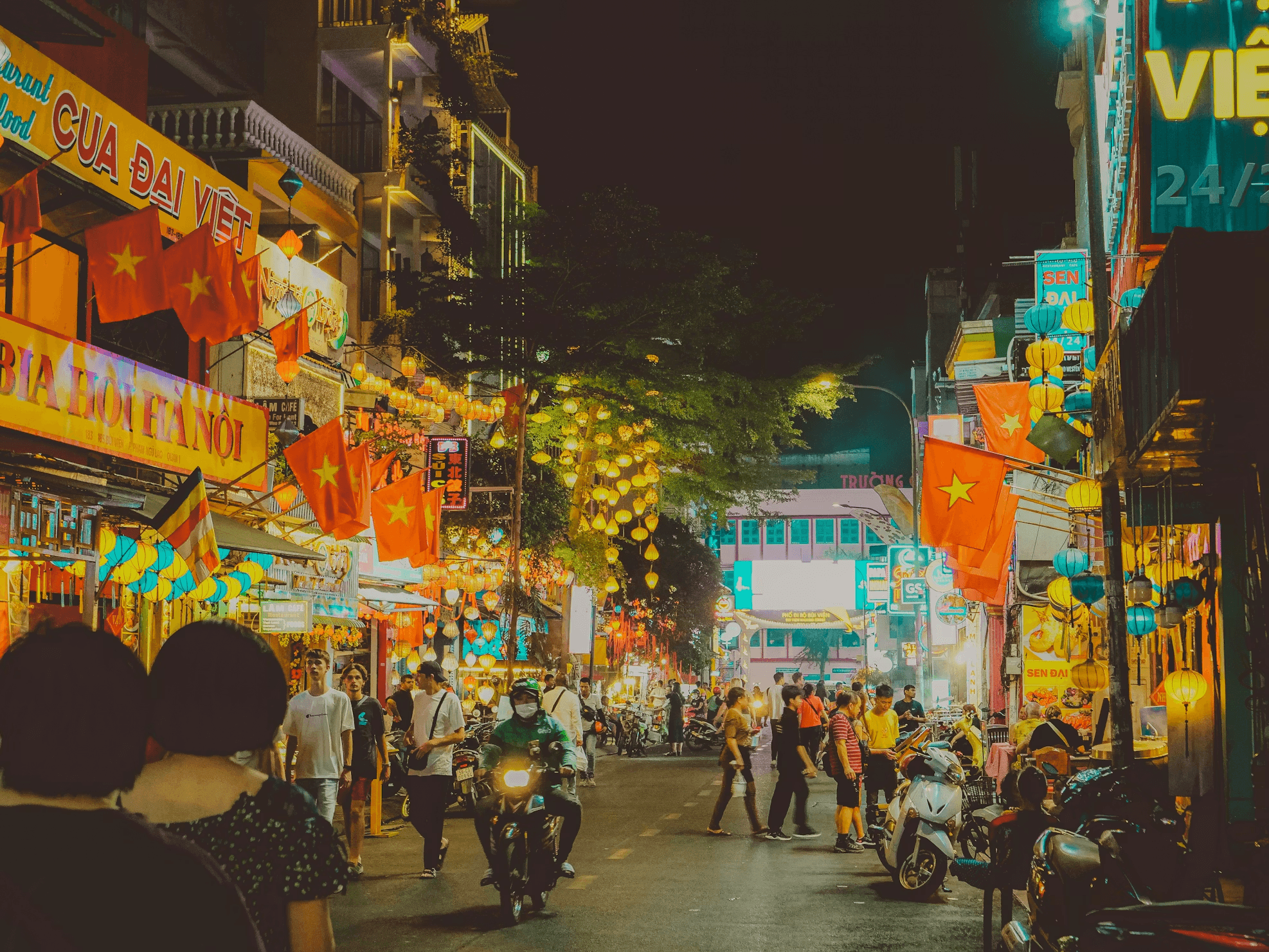
Saigon doesn't have one night market. It has a dozen. And they're not tourist attractions — they're just how people eat dinner.
Ho Thi Ky is my favorite and the one I keep going back to. It's technically a flower market (the biggest in the city), but after dark the food stalls take over. Over a hundred of them line the surrounding streets. The vibe is chaotic and loud and completely wonderful. This is where I had the snails. Also the best bò nướng lá lốt (grilled beef wrapped in betel leaves) of my life. And a dish called bánh tráng trộn — mixed rice paper — that's basically Vietnam's version of a snack salad. Shredded rice paper, dried beef, quail eggs, herbs, chili, and a squeeze of lime. Addictive doesn't begin to cover it.
Bến Thành Market's night section is the famous one, and it's fine. Good for first-timers. But the real Saigon food experience happens in the neighborhoods — District 4, District 10, Gò Vấp. That's where the prices drop, the locals outnumber the visitors ten to one, and the food gets genuinely adventurous.
QR payment coverage in Saigon is the best I saw anywhere in Vietnam. I'd estimate 95% of stalls I visited had a code, including the tiny hole-in-the-wall operations. The few that didn't were the absolute smallest — a guy with a grill and a cooler, that kind of thing. For everything else, I was scanning and swiping without thinking about it.
The Payment Reality at Vietnamese Night Markets
Let's talk about this honestly, because it matters if you're planning a trip.
Vietnam's QR payment infrastructure through VietQR is genuinely impressive. It's a standardized national system backed by NAPAS, and it works across dozens of banking apps. As a foreigner without a Vietnamese bank account, you'd normally be locked out of this entirely. That's the whole reason I was using Moreta — it lets you tap into the VietQR network without needing a local account or phone number. Top up your wallet, scan the code, confirm. Done.
At night markets specifically, here's what I found over three weeks:
In major cities (Hanoi, HCMC, Da Nang), roughly 90 to 95 percent of food stalls had QR codes. In smaller cities and tourist towns (Hội An, Huế, Nha Trang), more like 80 to 85 percent. At rural or floating markets, it dropped to maybe 60 percent.
The stalls that didn't have QR codes were almost always the most informal ones — someone selling fruit from a basket, or a grandma with a single pot of soup and no printed menu. For those, you need a little cash. I'd recommend keeping ₫200,000 to ₫300,000 on you as backup (that's $8 to $12), but using QR for everything else.
The speed difference is real, too. At busy night markets where lines get long, paying by QR is faster than fumbling with bills and waiting for change. Vendors prefer it because they don't have to touch money while handling food. I watched a bánh mì seller in Da Nang serve twice as fast when customers scanned versus paid cash.
What to Actually Eat: A Cheat Sheet
If you're staring at a night market stall with no English menu and no idea what to point at, here's where to start:
Hanoi: Bún chả (grilled pork with noodles and herbs), bánh cuốn (steamed rice rolls), and phở cuốn (phở wrapped in rice paper instead of served as soup). Also egg coffee — find it at a café near the market after you eat, not at the market itself.
Hội An: Cao lầu (the noodle dish unique to this city), bánh mì (Hội An's version is famous for good reason), and cơm gà (chicken rice). White rose dumplings if you see them.
Da Nang: Seafood. All of it. Also bánh xèo and mì quảng (turmeric noodle soup with pork and shrimp).
Ho Chi Minh City: Ốc (snails — just try them), bò nướng lá lốt, bánh tráng trộn, and hủ tiếu (southern-style noodle soup that's lighter than phở). Late night: hit a cơm tấm (broken rice) spot. Every neighborhood has one that's open until 2 AM.
A Few Things Nobody Tells You
The best night market food in Vietnam is almost never at the stall with the English sign. Follow the crowd. If twenty Vietnamese people are lined up somewhere, that's your spot.
Bring wet wipes. You'll be eating with your hands more than you expect. Stools are low and sometimes wobbly. Embrace it.
Prices at night markets are generally fixed — this isn't a negotiation situation for food. Souvenirs, yes. Phở, no. If a bowl costs ₫40,000, it costs ₫40,000 for everyone.
And this is important: drink the sugarcane juice. Fresh pressed, served over ice, sometimes with a squeeze of kumquat. It costs basically nothing and it's the perfect thing between spicy dishes. Every night market in Vietnam has at least one sugarcane press going.
The Bottom Line
Vietnam's night markets are the single best food experience I've had in Southeast Asia. Better than Bangkok's Yaowarat. Better than Penang's Gurney Drive. The quality is higher, the prices are lower, and the variety is staggering — from delicate Hội An dumplings to Saigon's chaotic, wonderful snail alleys.
The fact that you can do almost all of it cashless now just makes it easier. Download Moreta before you fly, load up your wallet, and start scanning. Keep a little cash for the edges. And for the love of everything, try the snails.
You'll thank me later.