
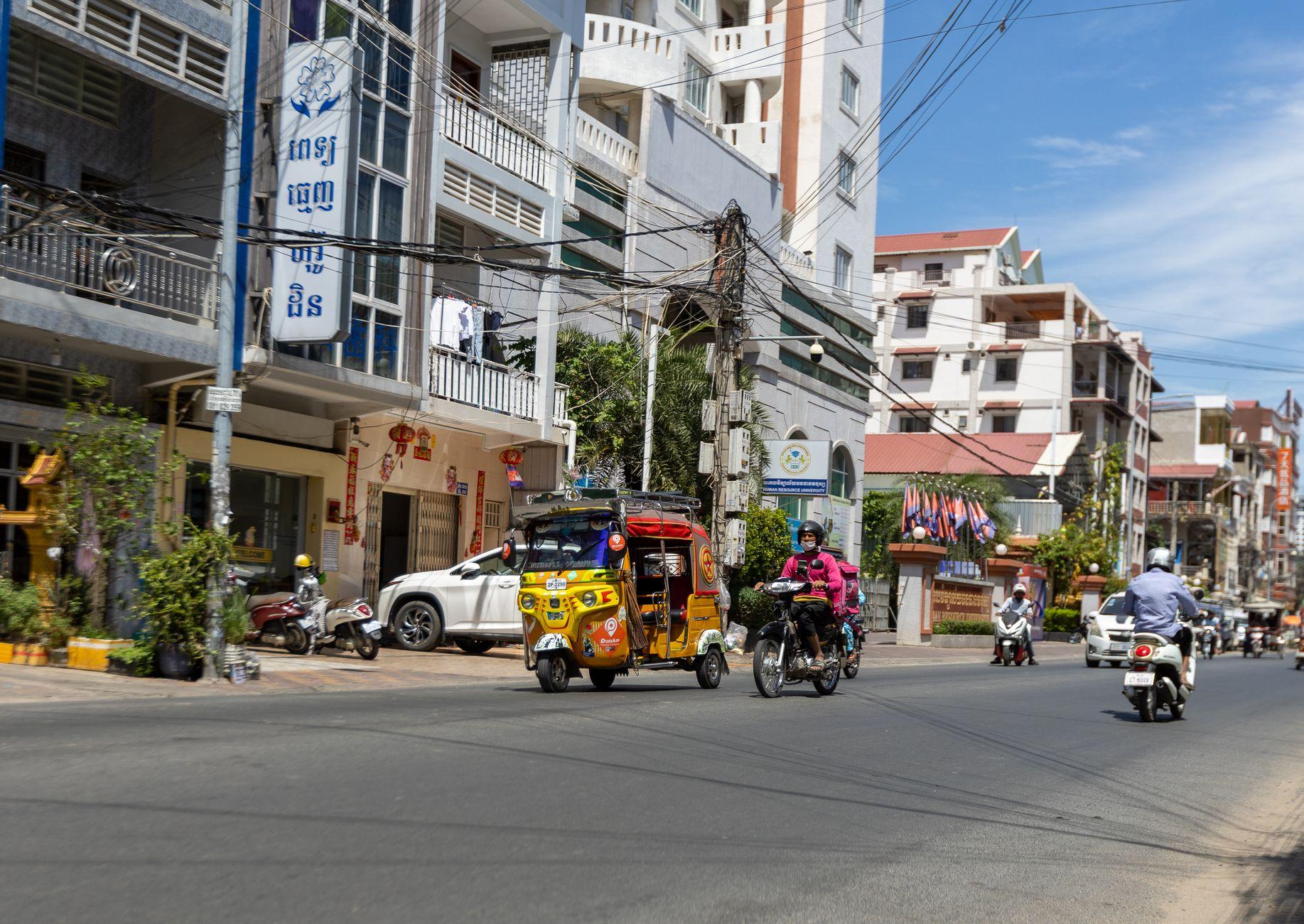
Buy a coffee in Phnom Penh and you will probably see the price in US dollars. Pay with a ten dollar bill and your change comes back as a mix of smaller dollars and a stack of Cambodian riel notes, calculated at a rate the shop decides. By your third day you are carrying two currencies, doing mental math at every counter, and quietly accumulating a brick of 100 riel notes that almost nothing costs.
This is the part of Cambodia that guidebooks undersell. The temples are easy. The money is weird. And the single best tool for making it less weird is a red and white QR code called KHQR that now sits on nearly every counter, taped to tuk tuk dashboards, and propped up next to the mango lady's cutting board.
So how should a visitor actually pay in Cambodia in 2026? There are four real options. Let's weigh them honestly.
Option one: cash, the default that punishes you in small ways
Cash works everywhere in Cambodia, full stop. Remote villages, ferry crossings, temple donation boxes, the guy who fixes your motorbike tire on the side of Highway 6. You need some.
But the dual currency system makes cash uniquely annoying here. US dollars handle anything above roughly a dollar, riel handles everything below it, and the two mix in a single transaction. A $3.50 meal paid with a five might get you one dollar back plus riel for the fifty cents, converted at whatever rate the stall uses. Torn or worn dollar bills are often refused outright, which is a genuine problem since the dollars that circulate in Cambodia have been circulating for a long time. And the riel change piles up faster than you can spend it, because the notes come in small denominations and vendors themselves are often short on change.
Add ATM withdrawal fees on top (Cambodian ATMs typically charge foreign cards per withdrawal, plus whatever your home bank adds), and cash becomes an option you tolerate, not one you choose.
Option two: your foreign card, welcome in a narrow slice of the country
Visa and Mastercard work fine at hotels, upscale restaurants in Phnom Penh and Siem Reap, bigger supermarkets, and chains. If your trip consists entirely of those places, a good no-foreign-fee card covers you.
The problem is that the interesting parts of Cambodia are not those places. The night market in Siem Reap, the crab shacks in Kep, the drink cart outside Angkor Wat at sunrise, the tuk tuk back to your guesthouse. None of them take cards, and most never will, because card terminals cost money and KHQR stickers do not. Cards also do nothing to solve the dual currency change problem, since the places that take cards were never the places giving you fistfuls of riel anyway.
Cards are a fine backup. They are not a plan.
Option three: a local wallet, if you can get one
Cambodians pay each other through apps like ABA Mobile, Wing, and ACLEDA, all connected through the National Bank of Cambodia's Bakong system. Bakong is the reason one QR standard, KHQR, works across every bank and wallet in the country. Scan any KHQR code with any participating app and the payment clears instantly, in dollars or riel, with no change to count and no rate to argue about.
Watch a local pay for noodles and you will understand why QR won here: the exact amount moves, in the exact currency the merchant priced in, and nobody rummages for small notes. KHQR exists partly because small change in riel is a hassle for merchants too.
Can you join? Sometimes. Opening a full local account generally requires showing up at a branch with your passport, and features for foreigners vary by bank and visa situation. For a long-term expat with a work visa and patience, a local ABA account is genuinely worth the branch visit. For a two-week visitor, it usually is not, and tourist-oriented Bakong access has been inconsistent. You also still need to fund the wallet, which loops you back to international transfers or cash deposits.
Option four: scanning KHQR with a wallet you already set up at home
This is where Moreta Pay fits. It is a wallet you load before you fly, from your own bank in your own currency (US bank via Plaid or ACH, SEPA in Europe, UK Faster Payments, Canadian e-Transfer, or an international card). In Cambodia, you point it at the same KHQR codes locals scan. The app shows you the merchant name, the amount, and the exact FX rate before you confirm, then pays the merchant instantly in local currency.
What that solves, specifically, in Cambodia:
- The dual currency math disappears. Whether the stall prices in dollars or riel, you see one clear number in your home currency before confirming.
- No change, so no riel brick in your pocket and no debates over a worn five dollar bill.
- No ATM runs, and no mystery markup, because the rate is on screen before you tap confirm.
- It reaches the places cards never will, because if there is a KHQR sticker, you can pay there, and there is almost always a KHQR sticker.
The honest limitation: it needs a data connection, and it does not help at the handful of places that are still cash only, mostly rural stops and some temple-adjacent vendors. Which is why the realistic answer is not Moreta Pay instead of everything, it is Moreta Pay plus a modest cash reserve.
A sensible split for a Cambodia trip
Here is the allocation that actually works on the ground. Carry maybe a day or two of cash, in smaller dollar bills in good condition, and spend your riel change on water and snacks as you go rather than letting it accumulate. Keep a no-foreign-fee card for hotels and anything with a formal till. Then do everything in between, which is most of your spending, by scanning KHQR: markets, tuk tuks, cafes, pharmacies, the barbershop, the fruit shake stand. Moreta Pay also covers QR-based checkouts on platforms like Agoda and Trip.com when you are booking the next leg from your guesthouse bed.
If Cambodia is one stop on a longer Southeast Asia route, the same wallet carries over, and the logic is similar in neighboring countries: Vietnam has its own national QR standard taped to every counter, and Laos presents its own cash headaches that QR neatly sidesteps. One setup at home, and the QR stickers in all three countries become usable.
Cambodia's money system looks complicated from the outside: two currencies, picky bill standards, perpetual change shortages. But the country quietly built one of the cleanest QR payment systems in Asia to route around all of it. The locals already made the switch. Set up Moreta Pay before you land and the red and white stickers on every counter start working for you too.