
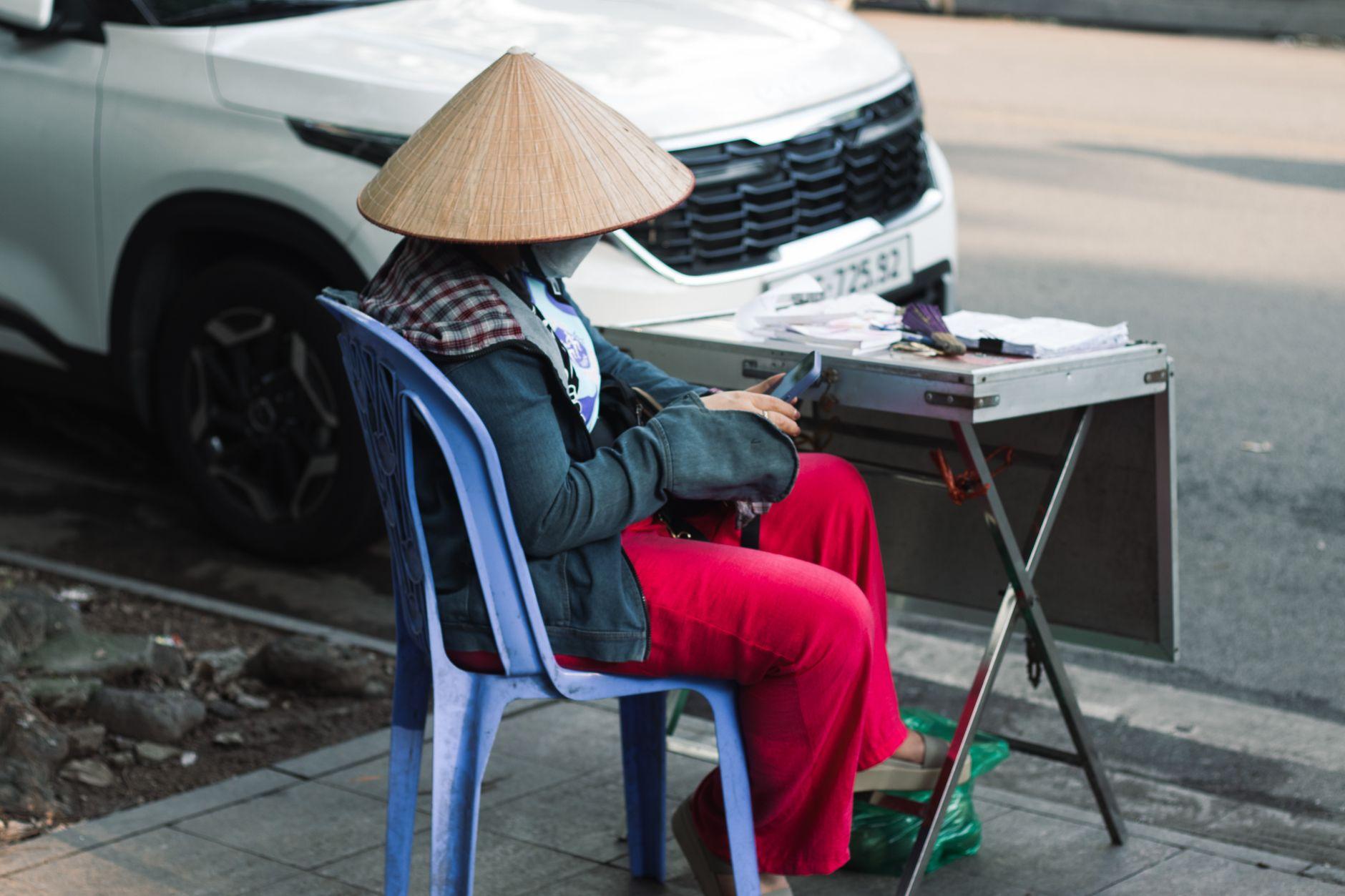
It is 7:40 in the morning on a side street in Hanoi's Old Quarter. The banh mi lady has a line of six people, and not one of them hands over cash. Each customer points a phone at a laminated card zip-tied to the glass case, taps twice, shows her the screen, and walks off with breakfast. When your turn comes, you hold out a 100,000 dong note. She sighs, digs through a plastic tub for change, and the line behind you grows. You are not doing anything wrong exactly. You are just paying like it is 2016.
Vietnam has quietly become one of the most QR-forward countries in Asia. The shift happened fast, and it caught a lot of travelers off guard, because the country's reputation (cash only, ATMs everywhere, bring small notes) is about five years out of date. Here is what paying in Vietnam actually looks like now, and how to join in without opening a Vietnamese bank account.
The laminated card is the whole system
The standard here is VietQR, a national QR format that works across Vietnamese banks. A cafe owner in Da Nang generates a code tied to her bank account, prints it, laminates it, and tapes it to the counter. Done. Locals open their bank app, scan, enter the amount or confirm the one that pops up, and the money lands in her account almost instantly.
Because it is that cheap and that simple for merchants, you will see those codes absolutely everywhere: coffee carts, pho shops, motorbike mechanics, fruit vendors with a basket on a bicycle and a QR code clipped to the handlebars. Night markets in Ho Chi Minh City, tailor shops in Hoi An, the woman selling che on a plastic stool. If a business has a bank account, it probably has a QR code, and often that code is the only non-cash option on offer.
Many places also display codes from bank apps or wallets like MoMo and ZaloPay, but VietQR is the common language. When a local says they will chuyen khoan (transfer), scanning one of these codes is usually what they mean.
So why can't you just scan it?
Here is the catch for visitors. Those bank apps require a Vietnamese bank account, which requires residency paperwork most travelers and even many long-stay expats do not have or do not want to deal with. Your home banking app will not recognize a VietQR code. So locals have the easiest payment experience in the country, and you are locked out of it by default.
This is where a wallet like Moreta Pay fits. You top it up from your own bank at home, in your own currency, and then scan the exact same VietQR codes the locals use. The app shows you the amount in dong, the merchant name, and the FX rate before you confirm anything, so you know what you are paying before the banh mi lady sees the green checkmark. No Vietnamese bank, no counting change on a busy sidewalk.
One practical note: wallet top-ups from a US bank via ACH are not instant, so load up a day or two before you fly, not while standing in line. We wrote a whole guide on how early to send an ACH top-up before paying QR codes abroad if you want the details.
Where your foreign card will and won't save you
Plenty of travelers land in Vietnam assuming their Visa or Mastercard will carry them through. It will, in a narrow slice of the country: international hotels, big malls in Hanoi and Ho Chi Minh City, chain restaurants, airport shops. Step outside that slice and card terminals get rare fast. The family-run restaurant with the best bun cha in the neighborhood almost certainly does not have one. The homestay in Ha Giang definitely does not. Even some mid-range spots that technically have a terminal will grimace at a foreign card and quietly point at the QR code instead.
So the real-world hierarchy in Vietnam looks like this: QR first, cash second, card a distant third. Travelers who only cover the third option end up doing constant ATM runs to cover the second, while everyone around them uses the first.
Yes, keep some cash anyway
Let's be honest about the other side. Cash is still very much alive in Vietnam. Some street vendors are cash only, especially older sellers in rural areas and smaller towns. Parking attendants, some local buses, the occasional market stall where the QR code has faded past scannability, all of these want notes. The sensible setup is not zero cash, it is small cash. A modest stash of smaller notes for the genuinely cash-only moments, and QR for everything else. You will be surprised how slowly that stash shrinks once you can scan.
The win is not eliminating cash entirely. It is eliminating the ATM dependency, the fee-on-fee withdrawals, the fat wallet of dong you are nervously carrying through a night market, and the ritual of nobody ever having change for a 500,000 note.
Scanning beyond the street: Shopee, Agoda, and your electric bill
QR payments in Vietnam are not just a street-level thing. Online checkouts on platforms like Shopee, Lazada, Trip.com, and Agoda commonly offer a QR payment option at checkout. You pick it, a code appears on screen, you scan it with your phone, and the order is paid, no card number typed into a form, no mystery foreign transaction fee showing up weeks later. Moreta Pay handles these on-screen codes the same way it handles the laminated one at the coffee cart. For expats settling in for a few months, bill payments by QR are part of the same habit, which is a quiet quality-of-life upgrade when the landlord forwards you the electricity bill.
Longer-stay expats paying the same people every month (a cleaner, a motorbike mechanic, a Vietnamese tutor) will find the QR routine especially useful, and we covered that monthly rhythm for expats in Asia separately.
Small habits that make you look less like a tourist
Scan before you order gets done. At busy stalls, locals often have the payment screen ready by the time the food is handed over. Have the app open.
Show the confirmation screen. Vendors want to see the success screen with the amount. Angle your phone toward them and wait for the nod. Some places also have a speaker that announces incoming transfers, which is its own small joy the first time you trigger it.
Check the merchant name. VietQR codes carry the account holder's name. Glancing at it before confirming is a free fraud check, in case someone has taped their own code over the shop's.
Do not expect the vendor to know your app. They do not need to. The code is theirs, the scan is yours. If the dong lands in their account, nobody cares what is on your phone.
The line moves faster when you can scan
Vietnam rewards travelers who adapt quickly, and payments are the fastest adaptation you can make. One app, one scan, and the laminated card at every counter stops being a wall and starts being a door. If you want in on the VietQR side of the counter before your trip, get Moreta Pay set up and funded now, and let the banh mi line move the way it is supposed to.