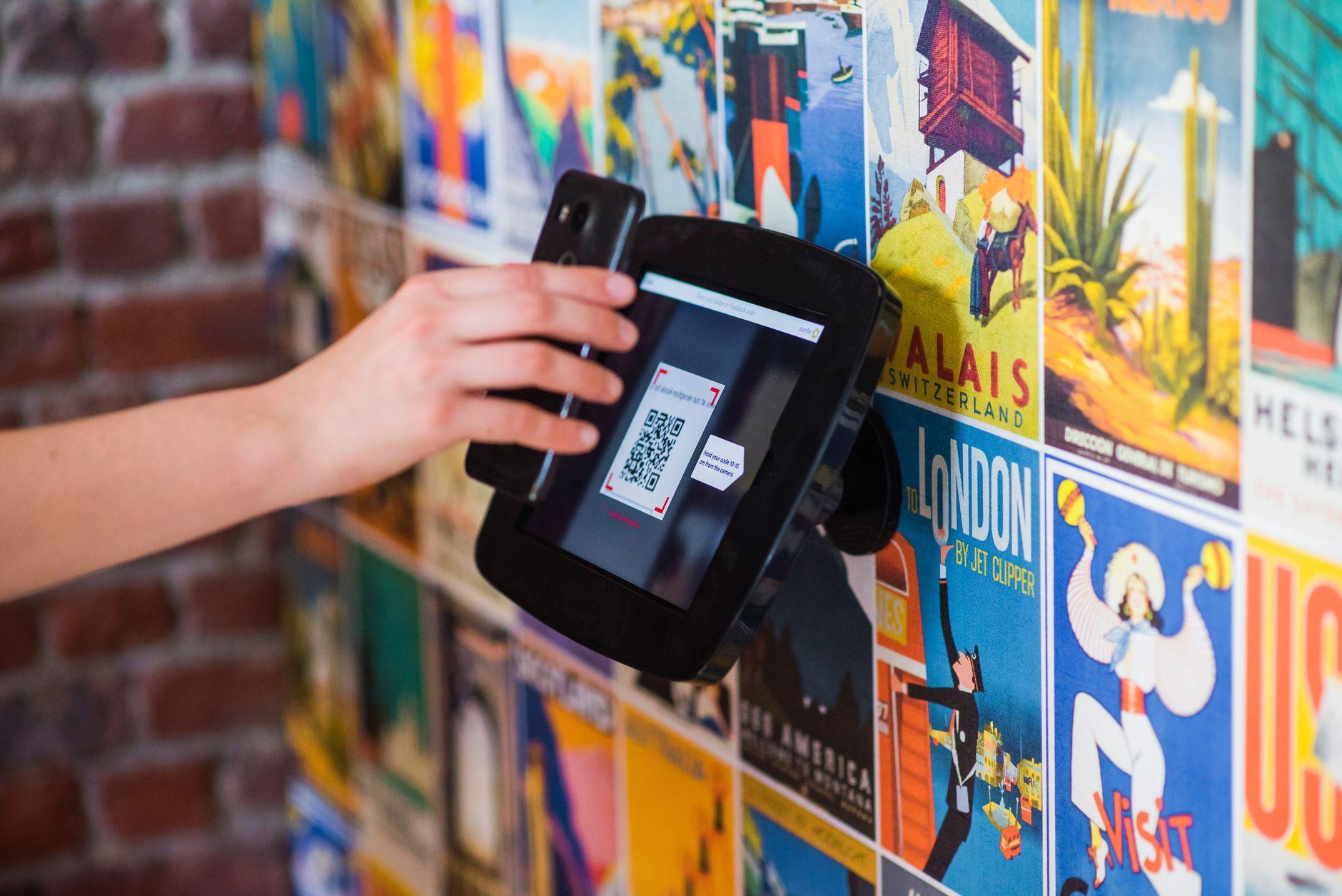

You are sitting at a mamak counter in Petaling Jaya, nasi lemak in front of you, when the vendor holds up a laminated QR code. You scan it from your wallet, confirm the amount and exchange rate, and tap confirm. The transaction settles instantly in local currency. Behind you in the queue, another customer pulls out cash, counts bills while the vendor waits patiently, and walks away with no record of the exchange at all. These two payment methods leave completely different records, and if you are planning a long stay in Malaysia or Cambodia on a long-stay visa, which story you generate matters.
Visa applications that ask for bank statements are looking for a pattern: regular income and finances that match what you claim. Cash spending leaves no ledger. QR spending does. In Cambodia especially, where a meaningful share of daily commerce still runs on physical riel and US dollar notes handed over directly, a nomad who relies solely on ATM withdrawals and cash transactions will have visible gaps in their financial trail. Malaysia's DuitNow QR system and Cambodia's KHQR standard give you a way to build that trail. A wallet that converts and spends through those local networks can generate transaction records that look more like income-matched local spending than scattered ATM receipts ever will.
What are the specific income proof requirements for long-stay visas in Malaysia and Cambodia?
Malaysia's DE Rantau program, run through the Malaysia Digital Economy Corporation, requires tech professionals to prove a minimum annual income of $24,000, documented through contracts plus recent payslips or invoices and bank statements (non-tech professionals need $60,000). That figure is fixed and codified, which makes the application process predictable: you know the number you need to hit before you apply.
Cambodia takes the opposite approach. It has no dedicated digital nomad visa, and its ER Retirement Visa, aimed at retirees, has no published minimum income threshold. Applicants instead submit general bank statements or pension documentation to demonstrate financial sufficiency, leaving the actual bar up to the discretion of the reviewing officer. Published thresholds are the norm across digital nomad visa programs globally, where income minimums typically fall somewhere between $2,500 and $5,000 a month [ellis.com], but Cambodia's lack of a hard number means there is no universal benchmark to plan around. That ambiguity is manageable if your finances are simple. It becomes a problem the moment your actual spending abroad does not match the tidy narrative your home bank statement tells.
Why do cash-heavy economies make income verification harder?
A bank statement is a ledger of digital transactions. Cash spending leaves no ledger at all. In Cambodia, a meaningful share of daily commerce, from tuk-tuk fares to market stalls selling num pang and fresh produce, still runs on physical riel and US dollar notes handed over directly. The National Bank of Cambodia reports fast growth in digital payments, which sounds like a digital economy on paper. But growth figures measure adoption, not the share of actual transactions conducted digitally versus in cash, and the exact cash-versus-digital transaction split for both Malaysia and Cambodia remains unpublished.
Here is the mechanism that actually creates the visa problem: immigration officers reviewing financial sufficiency are looking for a pattern, regular inflows, consistent withdrawals, a narrative that matches your stated income. If you withdraw a lump sum of cash at an ATM in Phnom Penh once a month and then spend it invisibly over the following four weeks, your bank statement shows one big withdrawal and nothing else. That is not fraud, but it is also not the clean, legible pattern an officer wants to see when deciding whether to renew your stay. Malaysia's DE Rantau pass, which asks for bank statements for the last three months under MDEC's published FAQ, rewards applicants whose finances are easy to follow. Cambodia's lighter documentation standard means the burden shifts instead to whatever bank statement or pension record you can produce, with no local spending trail visible at all.
How does Malaysia's DuitNow QR system change the picture for nomads?
DuitNow QR is Malaysia's unified national QR payment standard. Instead of every bank and e-wallet running its own proprietary QR code, DuitNow lets a single scan settle a payment regardless of which bank the customer or merchant uses underneath. For a digital nomad, this matters because every DuitNow transaction generates a digital record, whether you are paying for nasi lemak at a mamak stall in Petaling Jaya or settling a co-working desk fee in George Town.
That record-keeping is useful for two separate things. First, conversion happens at the point of a QR scan, and you see the exact rate and merchant amount before confirming, which tends to be more transparent than a currency counter at the airport. Second, and more relevant here, a visible QR transaction history gives you something closer to the pattern an immigration review is looking for: regular, dated, amount-specific local spending that lines up with the income you are claiming. Cash withdrawn from an ATM shows up as a single debit. A string of QR transactions shows up as a lifestyle.
Why doesn't Cambodia have an equivalent fix yet?
Cambodia does have KHQR, its own national QR standard, and QR adoption in cities like Phnom Penh and Siem Reap has grown substantially. But KHQR's reach does not extend evenly into the cash-first transactions, tuk-tuk negotiations, guesthouse deposits paid in dollars, rural market stalls, that make up a large share of a long-stay nomad's actual cost of living. Physical currency exchange remains common, particularly outside the capital, which means a chunk of your money movement never generates a record at all.
Building on the DuitNow comparison above, the practical difference is coverage, not technology. Cambodia's QR rail works where it is adopted. The gap is that cash still wins by default in enough everyday situations that a nomad relying solely on bank statements and KHQR receipts will still have visible holes in their spending trail. Cash will remain necessary in rural Cambodian villages, temple donations, and small parking fees. Keep a modest cash reserve for those gaps rather than assuming either country is fully cashless. For the bulk of day-to-day spending, a traceable QR-based record shows more to an immigration officer than a pile of ATM receipts ever will.
How can a digital wallet help close the gap between income proof and cash spending?
You top up the wallet from your home bank account or card in your own currency, scan the same local QR code a Malaysian or Cambodian merchant already uses, see the merchant name, amount, and exact FX rate before you confirm, and the merchant is paid instantly in local currency. The result is a dated, itemized transaction history in the app, with a receipt for each payment, that mirrors local spending instead of a handful of opaque ATM withdrawals. Your bank statement itself will show the top-ups, not each payment.
A quick walkthrough of how that payment actually works:
- Link your home bank account or card to the wallet.
- Top up your wallet balance; it converts to local currency at the live rate when you pay.
- Scan the merchant's existing DuitNow or KHQR code at checkout.
- Confirm the displayed amount and exchange rate.
- The merchant receives instant local currency; your record shows exactly what you paid, where, and when.
Frequently Asked Questions
Does Malaysia require a minimum income for its digital nomad visa?
Yes. The DE Rantau program requires tech professionals to prove a minimum annual income of $24,000 through active contracts or bank statements.
Does Cambodia have a fixed income requirement for its retirement visa?
No. The ER Retirement Visa has no legally codified minimum income figure; applicants submit general bank statements or pension documentation instead.
How many months of bank statements does Malaysia require?
For the DE Rantau pass, MDEC's FAQ asks for bank statements for the last three months, alongside contracts and recent payslips or invoices, to show your income.
Is Malaysia a cashless economy?
No. Malaysia has strong QR adoption through DuitNow, but cash is still used, particularly in smaller towns and informal markets.
Can I use local QR payments as proof of consistent spending for a visa renewal?
QR transaction histories are not an official substitute for required bank statements, but they can supplement your financial documentation with a clear, dated record of local spending.
Is currency conversion cheaper through a wallet than at an airport counter in Malaysia or Cambodia?
Point-of-payment conversion through a QR scan shows the exact rate before you confirm, which tends to be more transparent than a physical counter.
Does Cambodia have a national QR payment standard like Malaysia's DuitNow?
Yes, Cambodia uses KHQR, though cash remains common for many everyday transactions, especially outside Phnom Penh and Siem Reap.
Before you board
- Get your three months of bank statements ready for Malaysia's DE Rantau application or Cambodia's ER Retirement Visa submission. Print or download them now rather than scrambling later.
- Download a wallet that works through DuitNow or KHQR and link your home bank account or card before you arrive. Card, Apple Pay and Google Pay top-ups land instantly, but a US bank transfer can take one to three business days, so set it up from home before you fly.
- Keep a modest cash reserve on hand, ideally 200 Malaysian ringgit or 500,000 Cambodian riel, for rural areas, temple donations, and small vendors who do not use QR codes yet.
About Moreta
Moreta Global Inc. is a Delaware corporation and FinCEN-registered Money Services Business, backed by Y Combinator. The company built its wallet specifically for travelers navigating the gap between home-currency finances and local cash-and-QR economies across Malaysia, Cambodia, and 13 other countries in Asia, Latin America and Africa. Moreta Pay lets users top up from a home bank or card and pay directly through each country's native QR network, DuitNow in Malaysia, KHQR in Cambodia, with the exact exchange rate shown before every transaction. For travelers trying to keep a clear financial record while living in cash-heavy markets, that transaction-level transparency is a practical tool.
If you are planning a long stay in Malaysia or Cambodia and want a payment method that works with local QR rails while keeping a clear record of your spending, visit Moreta to learn more.