
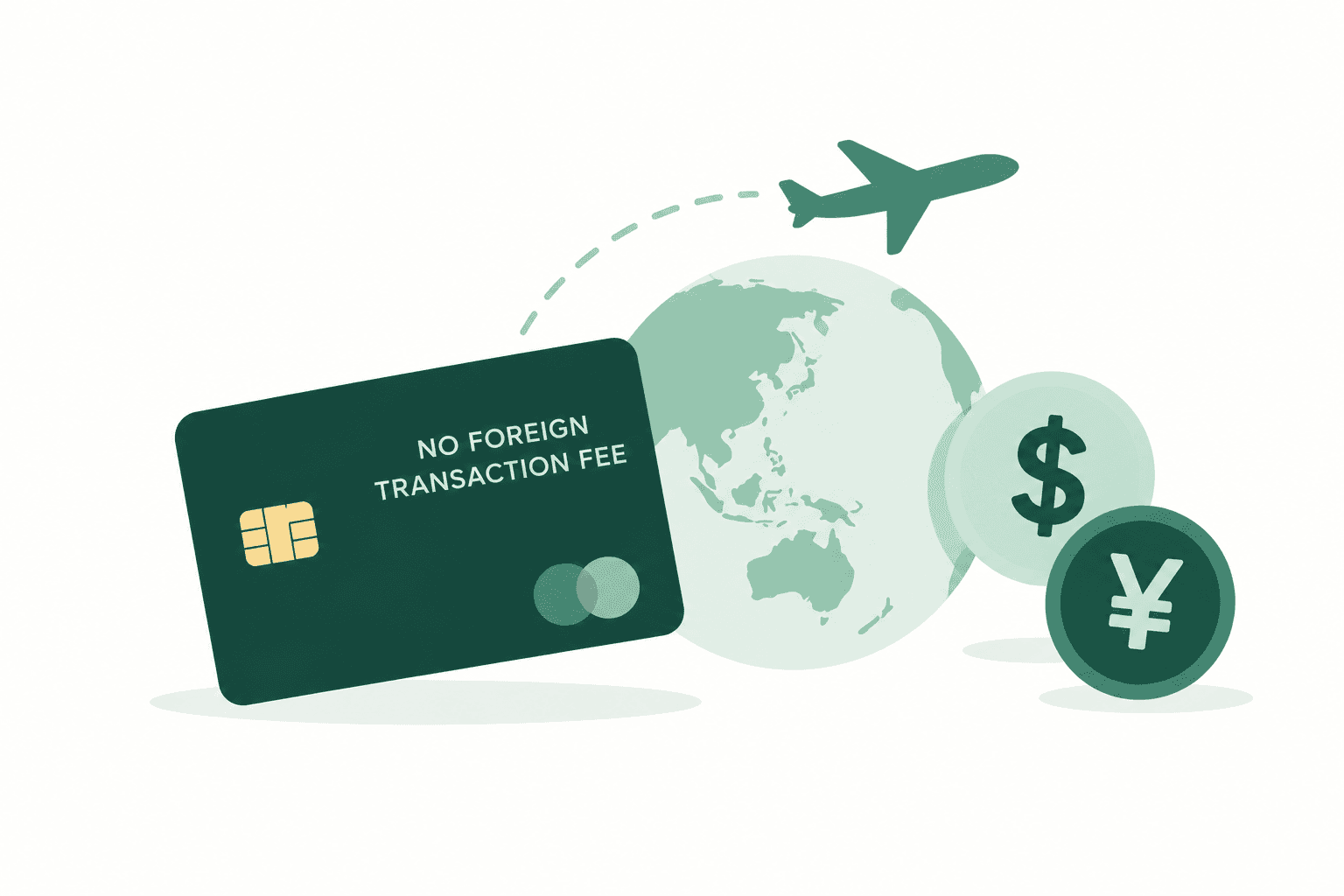
A vendor at a stall in Kuala Lumpur's Chow Kit market rings up your order, flips her tablet around, and shows you the total in ringgit. Your "no foreign transaction fee" card feels like a solved problem in your pocket. It isn't. The fee waiver only removes one line item, the flat 3% surcharge most banks charge on cross-border transactions [experian.com][td.com]. It says nothing about the exchange rate baked into the conversion itself, and that rate is where banks quietly make their money back. A card with zero foreign transaction fees can still cost you 2.5% to 5% more than the mid-market rate on every single purchase abroad, because the markup sits within the exchange rate, not the fee disclosure [ramp.com].
That distinction, between a disclosed fee and an undisclosed rate markup, is the whole story of why "no foreign transaction fee" is a marketing phrase, not a guarantee of a fair price.
What Does "No Foreign Transaction Fee" Actually Mean?
A foreign transaction fee is a flat surcharge, usually around 3%, that a bank tacks onto any purchase processed in a currency other than U.S. dollars [experian.com][td.com]. When a card is advertised as having no foreign transaction fee, that specific charge is waived. Nothing else changes.
The exchange rate applied to your purchase is a separate mechanism entirely. Your bank (or the card network processing the transaction) converts the local currency price into USD using its own rate, and that rate typically sits above the mid-market rate, the real, tradable exchange rate you'd see on a financial data terminal. Major banks apply a markup of 1% to 4% over mid-market as standard practice, and some go as high as 5% [ramp.com]. A card that removes the 3% fee but still applies a 4% rate markup has arguably done you no favor at all. You've traded a visible cost for an invisible one.
This is the mechanism worth understanding: fee and markup are two different levers, and issuers only ever advertise the one they've turned to zero.
Why Does the Exchange Rate Markup Cost More Than the Fee?
Because the markup applies to every purchase, silently, while the fee is a single line item you can at least see on your statement. A $200 dinner in Ho Chi Minh City with a 4% rate markup costs you $8 more than the mid-market conversion would, and there's no separate charge labeled "markup" for you to notice. It's baked into the number itself.
Compare that to how card networks handle currency conversion. Card networks apply their own currency conversion rate at the network level before your issuing bank adds anything on top, meaning even a card with a waived foreign transaction fee still passes through the network's conversion rate first. If your bank has additionally chosen a wide markup, the two compound. Over a two-week trip spending $3,000, a 4% average markup means roughly $120 gone before you've factored in a single ATM fee.
Some merchants and ATMs abroad will offer to charge you in US dollars instead of the local currency, a practice called dynamic currency conversion (DCC). It sounds convenient, but the exchange rate DCC applies is set by the merchant's terminal and is typically worse than your card network's own rate. The standard advice is to always decline DCC and choose to pay in the local currency instead, letting your card or wallet apply its own conversion rather than the merchant's marked-up one.
How Much Do ATM Withdrawals Actually Cost Abroad?
ATM withdrawal fees stack in a way most travelers don't anticipate. The average out-of-network international ATM fee is a flat charge of $2 to $5, and that's on top of a 1% to 3% foreign transaction fee applied to the withdrawal amount itself [chase.com]. Pull out 5,000,000 VND at a Sacombank ATM in Da Nang and you're paying that flat fee plus a percentage cut of the whole withdrawal, regardless of whether your card advertises fee-free purchases.
This is why ATM fees and withdrawal costs are such commonly searched terms: travelers get burned once, then start researching. The pattern repeats across regions, where out-of-network machines routinely combine a local surcharge with your home bank's international withdrawal charge. Despite this, industry surveys show that only about 10% of travelers actually rely on ATMs abroad, with most instead using cards directly or arriving with pre-exchanged cash specifically to avoid stacking these charges [bankrate.com]. The habit shift already happened, in other words. The tools to make it work well haven't fully caught up for everyone.
Is Wise or Revolut Actually Cheaper Than My Bank Card?
Generally, yes, and by a meaningful margin. Wise and Revolut both price their conversions at or near the mid-market rate, with fees typically under 1%, compared to the 2.5% to 5% markup a traditional bank card carries [bill.com]. If you're comparing fee structures specifically, both apply the same basic model, take the real exchange rate and add a small transparent fee, rather than hiding a markup inside a worse rate.
A practical alternative to a US debit card abroad is a wallet that shows you the exchange rate before you pay instead of after, such as Moreta Pay. See how its rate compares with a bank card, an ATM and airport exchange on the compare rates page.
But a rate advantage doesn't solve every problem you hit at the counter. Coverage of local payment rails varies by provider and by market. Wise offers direct integration with some local systems, such as Singapore's PayNow and Pix in Brazil. Where that native rail access isn't available, a competitively priced international card still asks a merchant to accept an international scheme rather than putting you inside the local rail the way a resident's own phone does. In São Paulo, Pix transactions run through Brazil's instant payment system directly between bank accounts, not through a card network at all.
What Is the Real Fix for Losing Money on Currency Conversion Abroad?
The fix is removing the conversion guesswork entirely, by seeing the exact rate before you commit to the payment, not after it posts to your statement three days later.
This is the specific gap Moreta Pay was built to close. You top up your Moreta wallet from your home bank, card, or (in supported markets) stablecoin balance, in your own currency. Then you scan the same local QR code the vendor already uses, whether that's DuitNow QR in Malaysia, KHQR in Cambodia, or other regional rails. Before you confirm anything, the app shows you the merchant name, the exact amount, and the FX rate applied, all on one screen. No markup surprise three weeks later on a statement you've stopped checking. Moreta operates as a FinCEN-registered Money Services Business, with funds at licensed partner banks and identity verification handled by Persona.
A rate comparison tool inside the app shows you, transaction by transaction, how the total spending power compares to what a bank card, Wise, or Revolut would have given you on the same purchase. That transparency is the actual differentiator, not a lower headline number, but a visible one, shown before you tap confirm rather than buried in a statement.
Frequently Asked Questions
Does a no-foreign-transaction-fee card guarantee a good exchange rate?
No. It only waives the roughly 3% surcharge some cards charge on international purchases [experian.com][td.com]. The exchange rate markup, typically 2.5% to 5% on major bank cards, is a separate charge that isn't affected [ramp.com].
How do card networks handle currency conversion?
Card networks apply their own conversion rate at the network level. Your issuing bank can then add a further markup or fee on top of that, so the two layers are independent of each other.
Are ATMs a good way to get cash abroad?
Usually not economical. Expect a flat fee of $2 to $5 per withdrawal plus a 1% to 3% conversion charge [chase.com], which is why only about 10% of travelers rely primarily on ATMs abroad [bankrate.com].
Is Wise cheaper than Revolut?
Both price close to the mid-market rate with fees generally under 1% [bill.com], making either meaningfully cheaper than a typical bank card's 2.5% to 5% markup [ramp.com]. The better fit depends on which currencies and countries you're using, not the fee structure itself.
Why do international money transfer fees vary so much between providers?
Because providers choose different combinations of flat fees, percentage fees, and exchange rate markups. A provider can advertise "no fee" while still profiting entirely from the rate spread, which is exactly the mechanism at play with traditional bank cards abroad.
About Moreta
Moreta Global Inc. is a Delaware corporation and FinCEN-registered Money Services Business, backed by Y Combinator. The Moreta app lets travelers top up funds from a home bank, card, or supported stablecoin balance and pay directly through local QR payment networks across markets including Malaysia, Cambodia, Brazil, China, the Philippines, Laos, South Korea, Mongolia, Peru, Colombia, Argentina, Bolivia, and Vietnam. Every payment shows the merchant name, amount, and exact exchange rate before you confirm, addressing the exact rate-transparency gap that leaves so many "no foreign transaction fee" cardholders overpaying without realizing it.
If you're tired of guessing what a purchase abroad actually cost until the statement lands, look at how Moreta Pay handles the conversion before you spend, not after. Learn more at Moreta.