
Here is the situation nobody fully prepares you for: you sit down at a noodle shop in Chengdu, eat a great bowl of dan dan mian, walk to the counter with cash, and the owner sighs. Not because she's rude. Because she genuinely may not have change, and hasn't needed any in years.
China is the most cashless large country on earth, and it got there without card terminals. The whole economy runs on QR codes tied to two apps. If you understand how that system works before you land, you'll have a smooth trip. If you don't, you'll spend your first two days discovering that your Visa is decorative.
The two apps that run everything
WeChat Pay (green) and Alipay (blue) are the entire payment landscape. Between them they cover street vendors, taxis, convenience stores, hospitals, temples selling incense, vending machines, and the lady renting pedal boats in the park. Most merchants accept both, and many just tape a single aggregated QR code to the counter that works with either.
Foreign card acceptance exists mainly at international hotels, airport shops, and some upscale malls in Beijing and Shanghai. Step outside that bubble and a physical card is close to useless. Cash is legal tender and technically must be accepted, but in practice small merchants often can't make change, taxi drivers wave it away, and some unstaffed shops literally have no way to take it. We went deeper on why cash is a losing strategy in Chinese cities in an earlier piece, so here let's focus on how the QR system itself works.
Two directions of scanning, and why it matters
Chinese QR payments happen in one of two ways, and knowing which is which saves you a lot of counter confusion.
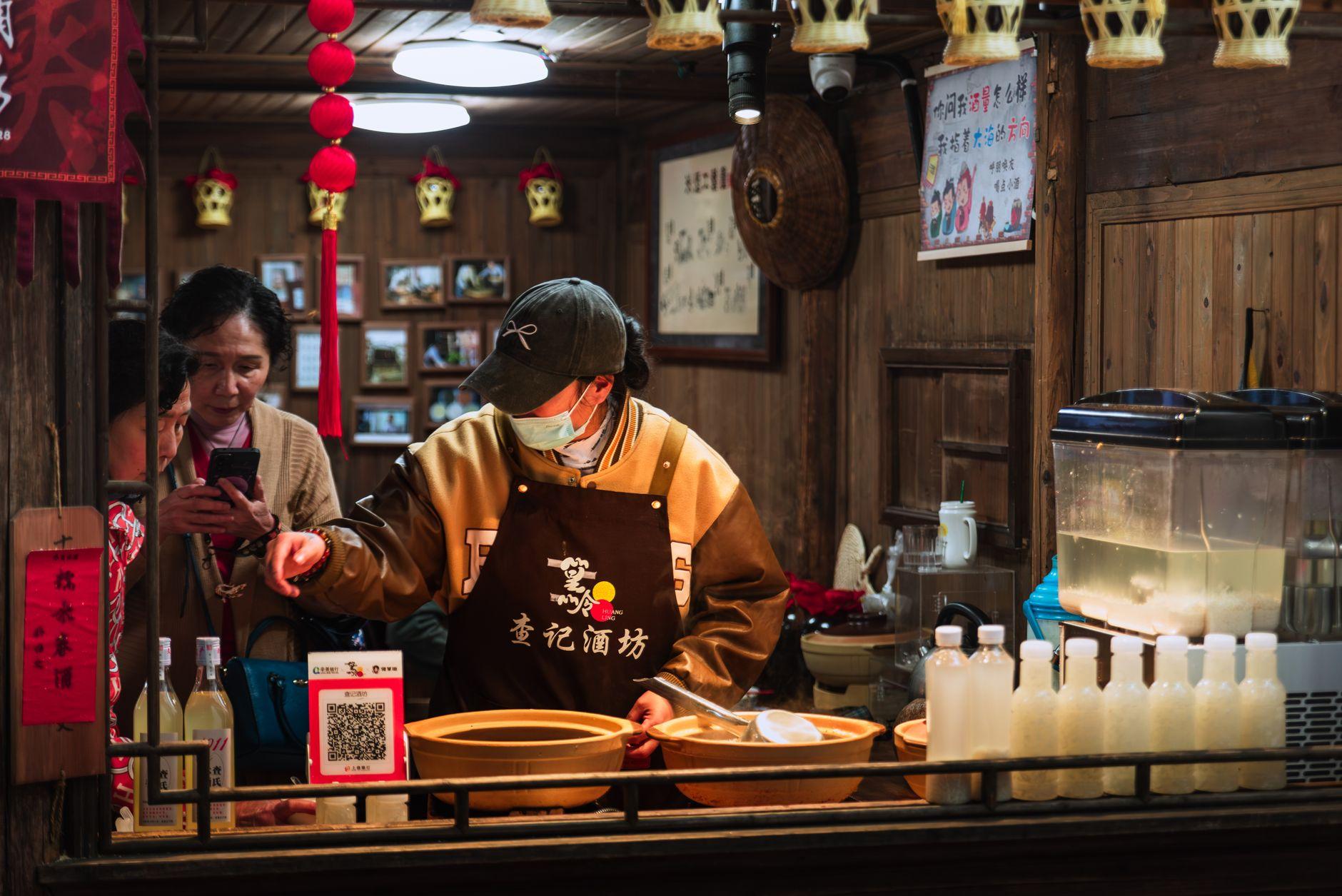
You scan them. The merchant displays a printed QR code, usually a laminated card or sticker near the register. You scan it with your phone, type or confirm the amount, and pay. This is the dominant mode at restaurants, market stalls, small shops, street food carts, and taxis. It's how most of China pays most of the time.
They scan you. At big supermarkets, chain convenience stores, and metro gates, the cashier points a scanner gun at a barcode on your phone screen. This mode requires you to be inside the Chinese app ecosystem with a payment code to display.
The good news for visitors: the first mode, scanning the merchant's code, covers the overwhelming majority of situations where travelers actually get stuck. And it's the mode you can join without a Chinese bank account. A wallet app like Moreta Pay reads the same WeChat Pay QR codes locals use, shows you the amount and the exchange rate in your own currency, and pays the merchant instantly from a balance you topped up back home.
What a payment actually looks like, step by step
Say you're buying jianbing from a breakfast cart in Xi'an. The vendor finishes folding your crepe and nods at the QR code zip-tied to the cart. Here's the whole transaction:
- Open your payment app and tap scan.
- Point your camera at the code. It resolves in a second, even if the laminate is scratched and sun-faded.
- Enter the amount if it's an open-amount code (the vendor will tell you, or show you on a calculator). Fixed-amount codes skip this step.
- Check the screen. With Moreta Pay you'll see the merchant name, the yuan amount, and exactly what it costs in your home currency before anything moves.
- Confirm. The vendor's phone chirps with a voice announcement of the payment, often from a little speaker box. That chirp is your receipt. Walk away eating.
The voice box matters more than you'd think. Vendors trust the chirp, not your screen. If their speaker announces the payment, you're done. If it doesn't, wait a moment before assuming anything went through.
Where visitors actually get stranded
Taxis. Drivers expect QR payment and many carry little cash. The code is usually mounted on the dashboard or the back of the headrest. Ride-hailing through Didi helps, but the street-hail taxi with a dashboard QR is still everywhere, and it's an easy scan if your wallet can read it.
Restaurants with table codes. Many places have replaced menus entirely. You scan a QR on the table, order from your phone, and pay in the same flow. Some of these ordering systems are locked inside WeChat mini-programs, which is one of the few corners of the ecosystem a foreign wallet can't reach. Workaround: wave down a server and ask to order in person, then pay the counter QR at the end. Smaller family restaurants handle this without blinking.
Unstaffed everything. Vending machines, self-serve drink fridges, photo booths, shared power bank rentals. These are QR-only by design. Some will scan fine, some are mini-program locked. Treat them as a bonus when they work, not a lifeline.
The metro. Most city metro systems want a transit code displayed from a local app, which falls into the they-scan-you category. Buy a physical transit card or single-journey token instead. Stations still sell them, and it sidesteps the whole problem for a few yuan.
Online bookings follow the same logic
The QR habit extends to screens. Booking a hotel on Trip.com or a tour through a local platform often ends at a QR payment screen rather than a card form. If your wallet can scan payment QR codes, you can settle these the same way you'd pay a noodle shop: scan the code on your laptop screen with your phone, review, confirm. Travelers coming from Southeast Asia will recognize the pattern, since it works the same way PromptPay QR codes do in Thailand.
Set yourself up before wheels down
Everything about China payments is easier if you arrive ready rather than troubleshooting on hotel Wi-Fi at midnight. Three things to do before your flight:
- Load a wallet from home. Moreta Pay tops up from your home bank (US banks via Plaid or ACH, SEPA in Europe, UK Faster Payments, Canadian e-Transfer) or an international card, in your own currency. Do it while you're still on familiar ground.
- Sort your connectivity. QR payments need data at the moment of payment. An eSIM activated before landing means you can pay for your airport coffee, not just stare at it.
- Carry a small cash reserve anyway. A few hundred yuan in small notes covers the rare temple donation box or rural bus. Think backup parachute, not primary plan.
China without cash isn't a stunt anymore, it's just how the country operates. The locals solved payments with a camera and a sticker, and there's no reason a visitor can't use the exact same stickers. Get Moreta Pay loaded before you board, and the first time a vendor nods at that QR code, you'll know exactly what to do.