
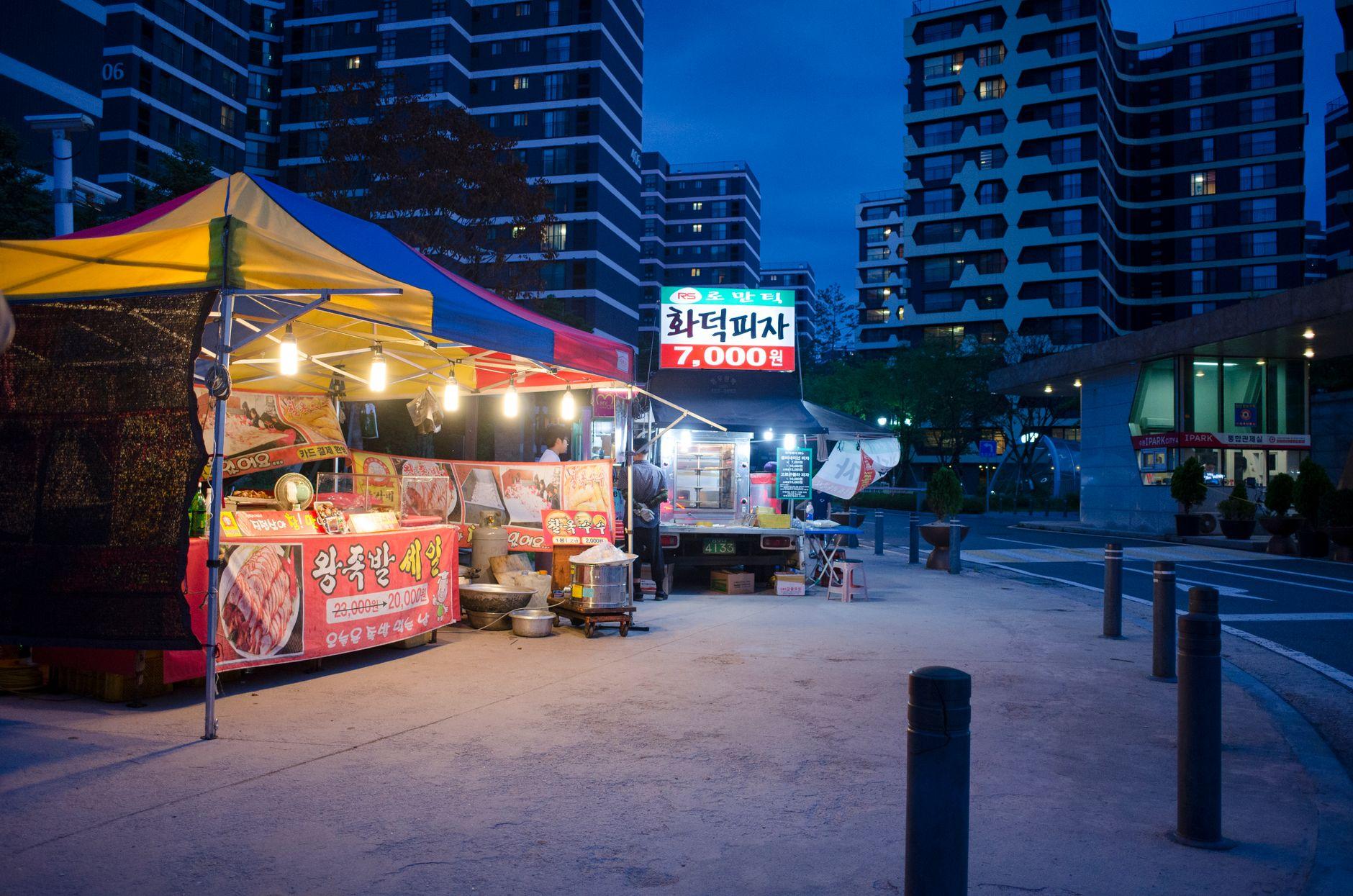
South Korea might be the most cashless country a digital nomad ever lands in. Your taxi driver taps a screen, the cafe downstairs only takes orders through a kiosk, and the ajumma running a tiny gimbap counter in a Seoul market points at a QR sticker before she points at anything else. Then you open the app store, download KakaoPay, and hit a wall: Korean phone number verification. Naver Pay, same story. The two apps that run daily life here are, for most short and medium term visitors, simply not available.
So how do you pay in South Korea when the country has moved past cash but its wallets are locked to residents? You have four realistic options. None of them is perfect on its own, so it is worth weighing them honestly.
Cash: legal everywhere, welcome almost nowhere
Korean won still works, obviously. Some old-school stalls in traditional markets, a pojangmacha tent late at night, a temple donation box, a countryside bus in a small town: cash gets you through these. If your trip includes rural Korea, carry some.
But in the cities, cash is increasingly treated as an inconvenience. Seoul has been phasing it out of city buses. Restaurant kiosks often have no cash slot at all. Staff at chain cafes sometimes have to hunt for a cash drawer key. And getting the cash in the first place means finding a global ATM that accepts foreign cards (not all Korean ATMs do), then paying for the privilege, often twice, once to your bank and once to the ATM operator.
Verdict: keep a modest reserve, but if cash is your main plan in Korea, you are swimming against the current in the country that invented the current.
Your foreign card: strong starter, weak finisher
Here is the good news. Korea is a card country at heart, and foreign Visa and Mastercard work in a huge share of places: convenience stores like GS25 and CU, Olive Young, coffee chains, department stores, most sit-down restaurants in newer neighborhoods. For a first week in Gangnam or Hongdae, a foreign card feels almost sufficient.
The cracks show up in three places. First, the self-order kiosks that have taken over casual dining will sometimes reject foreign-issued cards for no visible reason, leaving you waving at staff while a queue builds behind you. Second, the small eateries, market stalls, and family-run shops that make Korea worth lingering in often run on local payment only: a KakaoPay or Naver Pay QR, a Korean account transfer, or a local QR sticker. Third, every swipe can carry a foreign transaction fee, and some terminals will offer to charge you in your home currency (dynamic currency conversion), which is almost never in your favor. Always choose won.
Verdict: essential, but not complete. The places a foreign card fails are precisely the places locals eat.
KakaoPay and Naver Pay: the inner circle you cannot join quickly
These two apps dominate everyday payments. Locals split dinner through Kakao, pay delivery orders on Baemin, settle with friends, pay bills, all inside the same yellow or green interface. If you could use them, you would.
For most visitors, you cannot. Full verification typically requires a Korean phone number, and meaningful use requires a Korean bank account, which in turn usually requires an Alien Registration Card. If you are an expat settling in for a year or more, going through that process eventually makes sense, and it is a genuine quality-of-life upgrade. But it takes weeks, not minutes, and a nomad on a ninety-day stay will likely leave before the setup pays off.
Verdict: the best option for long-term residents, effectively a closed door for everyone else.
Local QR with a visitor's wallet
This is the gap Moreta Pay was built for. Those QR stickers at market stalls and small shops (Korea's traditional markets in particular have embraced QR acceptance, with networks like ZeroPay visible on countless counters) are scannable with Moreta Pay the same way a local would scan them. You point your camera at the merchant's code, see the amount, the exact FX rate, and the merchant's name on one screen, and confirm. Your wallet converts and the stall owner is paid in won instantly. No Korean phone number, no Korean bank account, no verification queue.
You fund the wallet from home before or during the trip: a US bank via Plaid or ACH, SEPA from Europe, UK Faster Payments, Canadian e-Transfer, or an international card, all in your own currency. There are no hidden foreign transaction fees, and because the rate is shown before you confirm, there is no post-dinner surprise on your statement. It also covers QR checkout on platforms like Trip.com and Agoda, which matters more than you would expect once you start booking KTX-adjacent hotels for weekend trips to Busan or Gyeongju.
To be fair about the cons: it is a wallet, so it needs a balance, which means a minute of planning. And not every Korean terminal is QR-based, so it complements a card rather than replacing it.
A Tuesday in Seoul, paid four ways
Morning americano at a chain cafe: foreign card, no problem. Lunch at a bindaetteok stall in Gwangjang Market: the stall is local-payment only, so you scan its QR with Moreta Pay while the person behind you does the same thing with Kakao. Afternoon co-working day pass: card again. Dinner at a tiny kalguksu place in a back alley: QR sticker by the register, scanned and done. Late-night snack from a pojangmacha tent: this one is cash, and you are glad you kept a few bills. That mix, with the QR wallet absorbing everything your card cannot reach, is roughly what keeps your cash needs down to a small buffer instead of a daily ATM habit.
How the stack actually settles
Let the conclusion emerge from the comparison. Cash is a backup, not a strategy. A foreign card is your workhorse for chains, kiosks that cooperate, and anything corporate. KakaoPay and Naver Pay are worth pursuing only if you hold an ARC and plan to stay long enough to justify weeks of setup. And for the local-only layer, the market stalls, the hole-in-the-wall restaurants, the QR stickers taped to a thousand counters, a visitor's QR wallet is the piece that makes South Korea without cash genuinely workable rather than theoretically workable.
Planning a Korea stint this year? Get your wallet topped up and ready before wheels down at Moreta Pay, so the first QR sticker you meet in a Seoul market is a lunch, not a problem.