
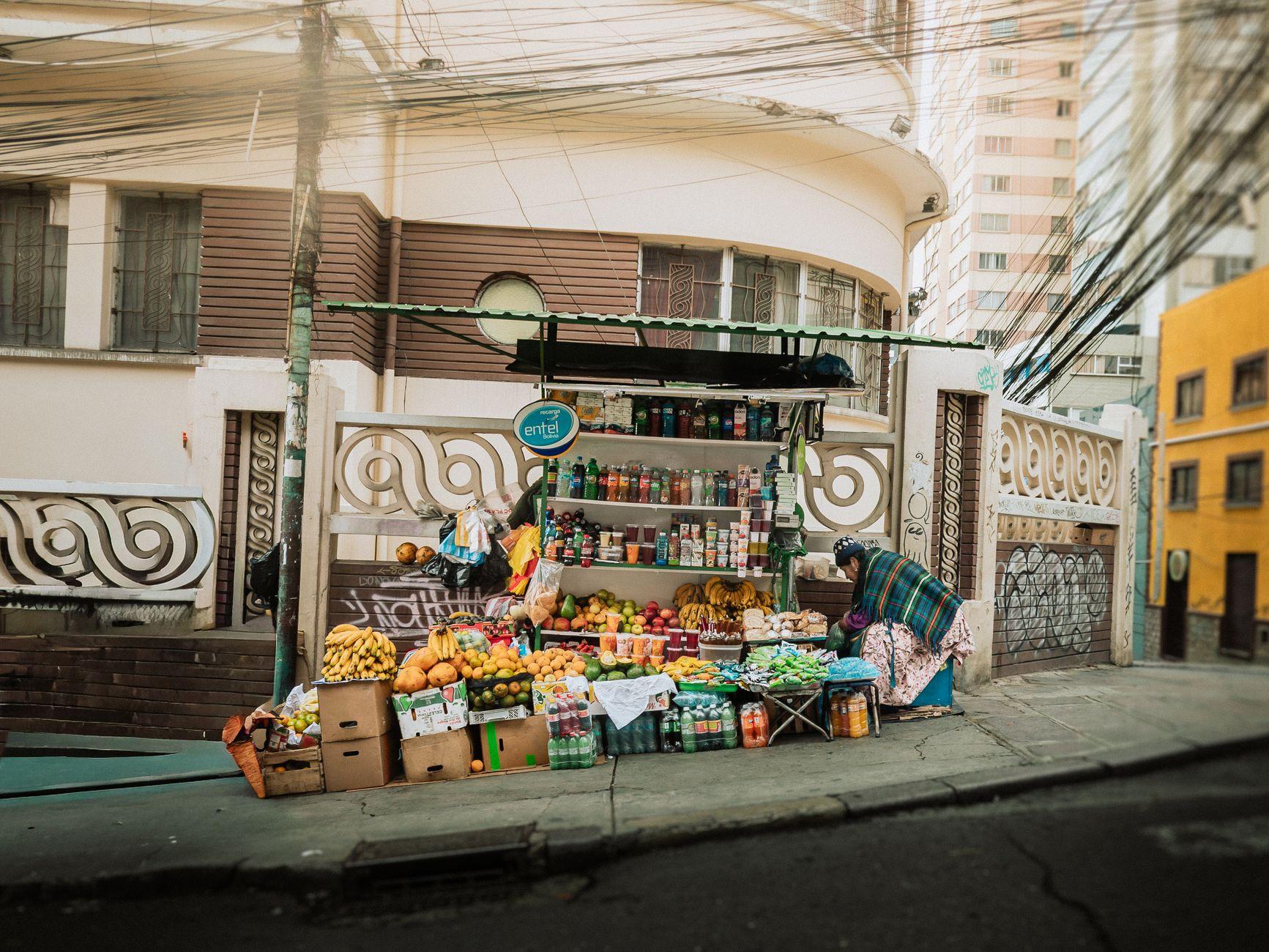
It's mid morning at Mercado Rodríguez in La Paz, and the casera behind the juice stand has already sized you up as a foreigner before you open your mouth. You order a jugo de tumbo, she blends it, hands it over, and you reach for your pocket. Then you notice it, taped to the front of her stand next to a faded price list: a laminated square with a QR code and a bank logo. She sees you looking and nods at it. "Con QR, si quieres."
Ten years ago this moment did not exist in Bolivia. Today it happens constantly in La Paz and Santa Cruz, and almost never in the rest of the country. Understanding that split is basically the whole game for how to pay in Bolivia as a traveler, so let's walk through it properly.
QR Simple, the code that quietly took over two cities
The code on that juice stand is almost certainly QR Simple, Bolivia's interoperable QR payment standard. The idea is straightforward: any Bolivian bank's app can scan any QR Simple code, so a vendor prints one code and gets paid no matter which bank the customer uses. That interoperability is why adoption has spread so fast among market vendors and street food stalls in La Paz and Santa Cruz. There's no card terminal to rent, no minimum purchase, nothing to plug in. A printed code and a phone are the entire setup.
You'll spot these codes in places that would surprise people who still picture Bolivia as purely cash: the salteña window that sells out by noon, the anticucho grill that appears on a Sopocachi corner after dark, the stall at Mercado Lanza pouring api morado with a pastel on the side. In Santa Cruz, walk through Mercado Los Pozos and you'll see the same laminated squares among the fruit pyramids.
The catch, and it's a big one for visitors, is that scanning a QR Simple code normally requires a Bolivian bank account. Your banking app from home will read the code and do nothing useful with it. This is where a wallet like Moreta Pay changes the picture: you scan the vendor's regular QR Simple code, see the amount and the exchange rate from your own currency, confirm, and the casera gets bolivianos instantly, without you ever opening a local account.
Where the QR map ends and the cash map begins
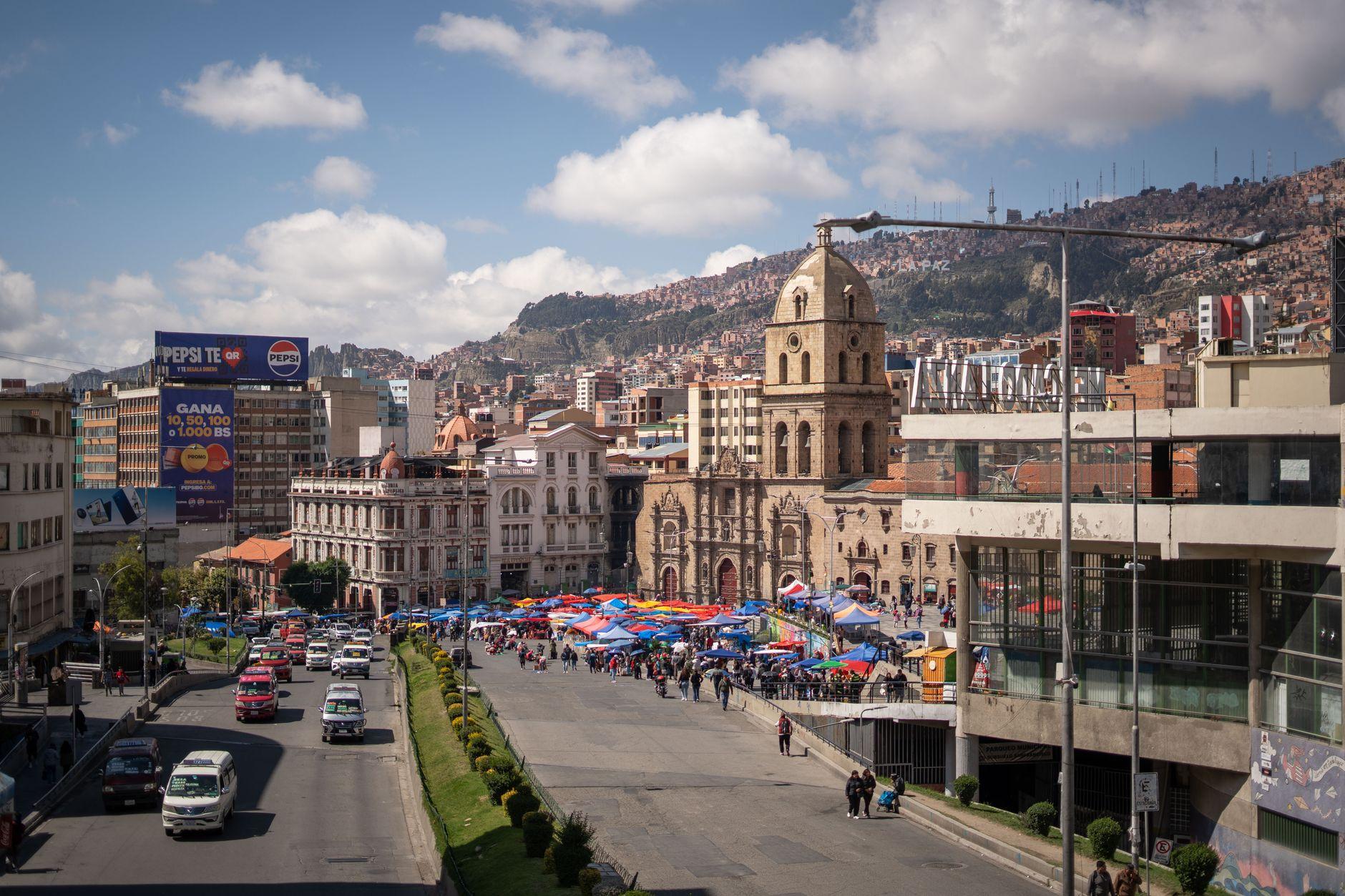
Here is the honest geography. La Paz and Santa Cruz are genuinely QR friendly at street level. El Alto is patchier but improving, especially among younger vendors at the enormous 16 de Julio market. Beyond those cities, assume cash until proven otherwise.
That matters because the places travelers actually go in Bolivia are mostly not La Paz and Santa Cruz. They're Uyuni, before a salt flats tour. Copacabana, on the way to Isla del Sol. Rurrenabaque, gateway to the Amazon. Sucre and Potosí. Villages along the Death Road. In these places, the choripán vendor, the market lunch counter serving sopa de maní, the woman selling coca leaves and bags of fresh cheese, they deal in cash, and often only in small cash.
So the realistic strategy for Bolivia in 2026 is not "Bolivia without cash." It's a hybrid: go QR wherever the code is taped up, and carry enough bolivianos for everywhere it isn't. The travelers who get burned are the ones who commit fully to one side.
The ATM trap outside the big cities
Now the part that catches people off guard. In La Paz and Santa Cruz, finding an ATM that accepts a foreign card is annoying but doable. Outside them, it can become a genuine problem. Machines that take international cards are scarce in smaller towns, and the ones that exist are sometimes empty, offline, or refuse your card for no stated reason. Plenty of travelers have stood in Uyuni the night before a three day salt flats tour realizing that none of the machines on the plaza will talk to their bank.
The practical move is to withdraw more than feels comfortable while you're still in La Paz or Santa Cruz, then treat that cash as your rural budget. And because you're now carrying real money, it's worth thinking ahead about what you'd do if it disappeared. We've written a country by country recovery plan for a stolen wallet that's worth skimming before any cash heavy trip.
There's a second benefit to paying QR in the cities: every jugo, every salteña, every market lunch you pay by scanning is cash you didn't spend, which means fewer ATM runs and a bigger buffer for the parts of Bolivia where cash is the only language.
The change problem nobody warns you about
Bolivian ATMs love dispensing 100 and 200 boliviano notes. Street vendors hate receiving them. Hand a 200 to a woman selling tucumanas for a few bolivianos each and you'll get the look, followed by "¿No tiene sencillo?" She may genuinely not have change, and you'll either wait while she asks neighboring stalls or lose the sale entirely.
Break big notes deliberately: at supermarkets, pharmacies, bus terminals, anywhere with a till. Hoard coins and 10s and 20s like they're precious, because at a market they are. This is another quiet argument for QR at the stalls that accept it. A scanned payment is always exact. No change negotiation, no holding up the line, no walking away hungry because neither of you could break a bill.
Reading the stall before you order
A quick field guide. If you see a laminated QR code taped to the stall, on the cooler, or hanging from string, you can scan it. If the vendor is older and the stall has no signage at all, assume cash. If you're unsure, ask before you order: "¿Aceptas QR?" is universally understood in La Paz and Santa Cruz. Vendors who take it will often say yes with visible relief, because it means they don't have to hunt for change either.
When you do scan with Moreta Pay, the confirmation screen shows the merchant name, the amount in bolivianos, and exactly what it costs you in your home currency before you commit. That transparency matters more than it sounds, because the alternative for most visitors is a foreign card with conversion happening invisibly somewhere behind the scenes. If you've never looked closely at how that works, our breakdown of why a "no foreign transaction fee" card still costs you money abroad explains the mechanics.
Your Bolivia payment kit, in one paragraph
Land in La Paz or Santa Cruz with your wallet already topped up from your home bank. Pay by QR at every stall, market counter, and cafe that displays a code, which in these two cities is more of them every month. Withdraw a cash reserve in small denominations before heading anywhere rural, guard your sencillo, and expect zero card or QR acceptance in small towns. That combination covers essentially every eating situation Bolivia will throw at you, from an api con pastel breakfast at Lanza to a plate of pique macho in a town whose only ATM has been out of order since last week.
The api will be hot, the salteña will drip on your shoes, and the paying part can just work. Set up Moreta Pay before you fly and the QR side of Bolivia is open to you from your very first market stall.