

The taxi has stopped outside your hotel in Beijing. The meter says 47 yuan. You hold out a crisp 100 yuan note, fresh from the airport exchange counter, and the driver looks at it the way you might look at a traveler’s cheque. He sighs, pats his pockets theatrically to show he has no change, then points at a laminated card zip-tied to the headrest. On it: two QR codes, one green, one blue. He taps the card twice. That tap is the entire payment infrastructure of modern China, and right now you are locked out of it.
This guide is about getting in. Not the theory of it, the actual mechanics: what the codes are, which direction the scanning goes, where you will meet them, and how a visitor with a foreign phone and a foreign bank can pay like everyone else does.
Green Code, Blue Code
China runs on two payment networks. WeChat Pay (the green one) lives inside WeChat, the messaging app that is also, functionally, the operating system of daily life. Alipay (the blue one) is its rival, born from online shopping and now everywhere offline too. Between them they cover essentially every transaction a person makes in a Chinese city, from a 3 yuan steamed bun to rent.
The important thing for a visitor to understand is that these are not “an option at checkout.” They are the checkout. Many small vendors keep no cash float at all. Some genuinely cannot make change because they have not touched a banknote in months. Cash is still legal tender, and larger businesses will grudgingly accept it, but at a noodle stall or in the back of a Didi, waving paper money marks you as someone who is about to slow the line down. And your foreign Visa or Mastercard is barely a factor outside international hotel chains, a reality we have written about in more detail for anyone still planning to swipe their way through Shanghai.
The Scan Goes Two Ways, and It Matters
Watch a checkout counter in Chengdu for five minutes and you will notice two distinct rituals.
You scan them. The merchant displays a printed QR code, usually a sticker on the counter, a placard by the register, or that laminated card in the taxi. You point your phone at it, type in the amount (or the amount appears automatically), and confirm. This is the standard at street stalls, small restaurants, taxis, and markets. It is also the format Moreta Pay works with: scan the merchant’s standard WeChat Pay QR code with the app, see the amount, the exchange rate, and the merchant’s name in plain terms, then confirm. Your wallet handles the conversion and the merchant is paid in yuan on the spot, exactly as if a local had paid.
They scan you. At supermarkets, convenience stores, and chain restaurants, the cashier asks you to show your payment code, a barcode on your screen, and zaps it with a handheld scanner. Locals flash this without breaking their sentence. As a visitor, you will encounter this at the big-name chains, but the vast majority of your daily spending, the food, the rides, the market finds, happens through the first ritual, the one where you do the scanning.
A Day in Xi’an, Priced Entirely in QR Codes
To make this concrete, here is roughly what a tourist day looks like through the lens of payment.
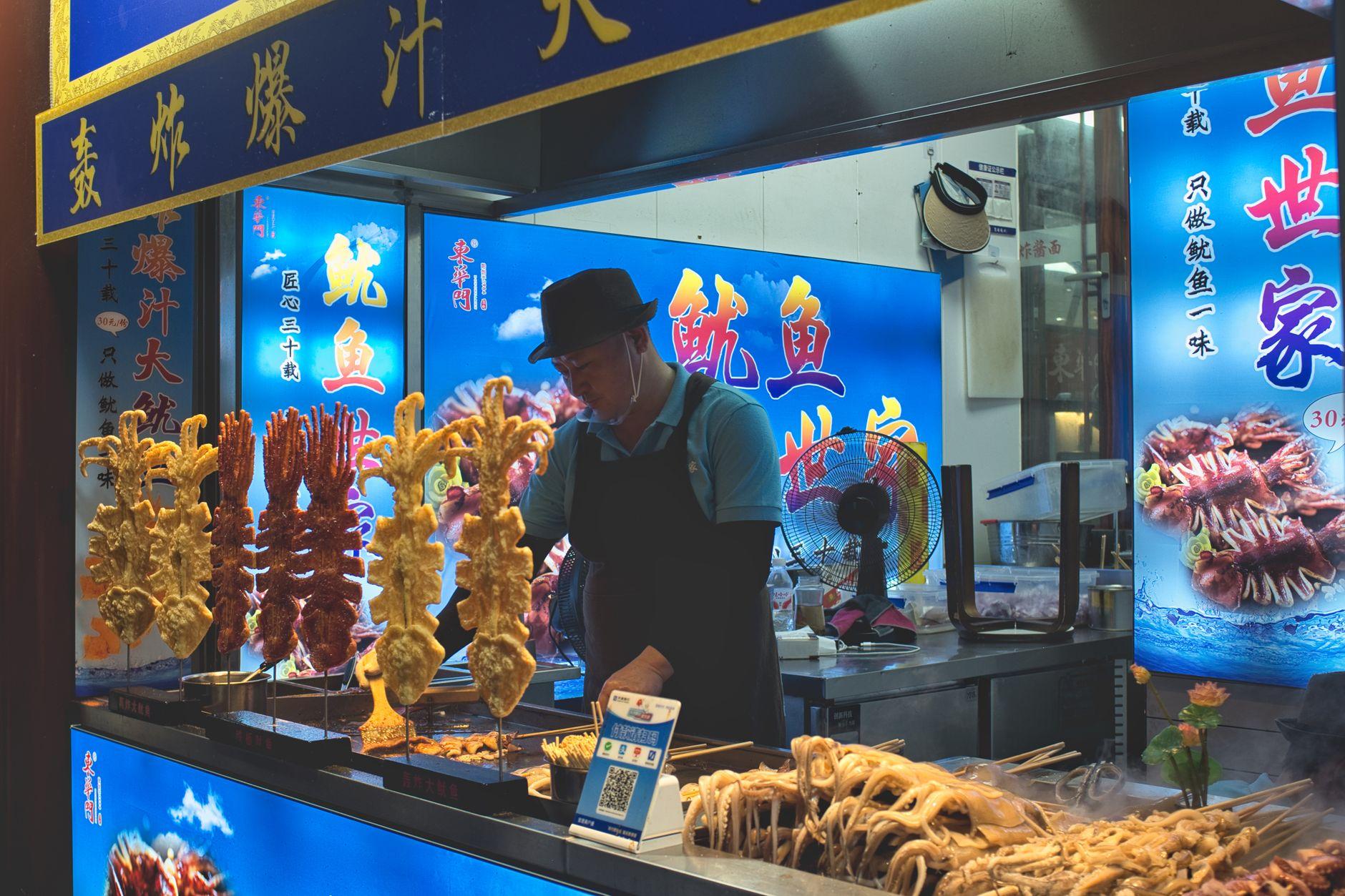
Breakfast is a bowl of hu la tang from a hole-in-the-wall with six stools. The QR sticker is taped to the wall next to the chili oil. Lunch in the Muslim Quarter: the man pulling biang biang noodles has his code hanging from the awning on a laminated placard, slightly splattered. The pomegranate juice cart, the calligraphy brush stall, the woman selling persimmon cakes from a bicycle, all QR. The musician outside the Bell Tower has a QR code propped in his open guitar case, and people genuinely scan it to tip him.
Then the less charming encounters. Some museum ticket machines take mobile payment only. Vending machines on metro platforms: QR. The evening Didi ride settles inside an app that expects a linked Chinese payment method. None of this is designed to exclude you. It is simply designed for a population that stopped carrying wallets years ago.
Why “Just Download the Local Apps” Is Harder Than It Sounds
Instead of setting up WeChat Pay or Alipay, a non-resident can use a travel wallet like Moreta Pay, which pays WeChat Pay merchant QR codes from a balance funded at home, with no Chinese bank account.
Both WeChat Pay and Alipay have opened up to foreign visitors in recent years, and plenty of travelers do get them working. But the setup has friction that people rarely mention until you are standing in arrivals trying to do it on airport Wi-Fi: identity verification with your passport, linking an international card and hoping it is accepted, and navigating an interface built primarily for a domestic audience. Some visitors sail through. Others hit a verification wall at 11pm with a hungry travel partner glaring at them.
This is where a wallet built for travelers earns its place. With Moreta Pay you top up before you even land, from a US bank via Plaid or ACH, SEPA in Europe, UK Faster Payments, Canadian e-Transfer, or an international card, all in your home currency. In China, you scan the merchant’s QR code as you would anywhere the app operates, review the rate before you commit, and pay. No local bank account, no ATM run, no guessing what the conversion cost you. If you have used QR wallets elsewhere in Asia, say PromptPay in Thailand, the muscle memory transfers directly.
Habits That Make You Look Like You Live There
Confirm the merchant name before you tap pay. Every legitimate QR payment shows you who you are paying. At a market stall, the name on screen should match the human in front of you (or at least their business). This is your protection against the rare swapped-sticker scam.
Show the confirmation screen. After paying, turn your phone toward the vendor. In busy stalls the vendor may not hear their notification chime, and the green success screen is the universal receipt.
Guard your battery like it is your passport. A dead phone in China is a payment outage. Carry a power bank. Locals do, religiously, and shared power bank rental stations exist on nearly every block for exactly this reason (paid by QR, naturally).
Keep a small cash reserve anyway. A couple hundred yuan in small notes covers the edge cases: a temple donation box, a rural bus, the one auntie in the village who prefers paper. Just do not build your trip around it.
It Extends Online, Too
The QR ecosystem does not stop at physical counters. Booking a hotel on Trip.com, ordering from Chinese e-commerce platforms, settling a utility bill if you are staying longer as an expat, much of it funnels through the same QR-based payment flows. Moreta Pay handles QR-based online checkouts on supported platforms as well as bill payments in supported countries, which matters more the longer you stay. For a nomad settling into a month in Kunming or Hangzhou, that is the difference between visiting the system and actually living inside it.
China without cash is not a prediction anymore, it is the Tuesday afternoon reality of a billion people. The taxi driver with the laminated card is not being difficult. He is showing you the door. Set up Moreta Pay before your flight and walk through it like you have been here for years.