
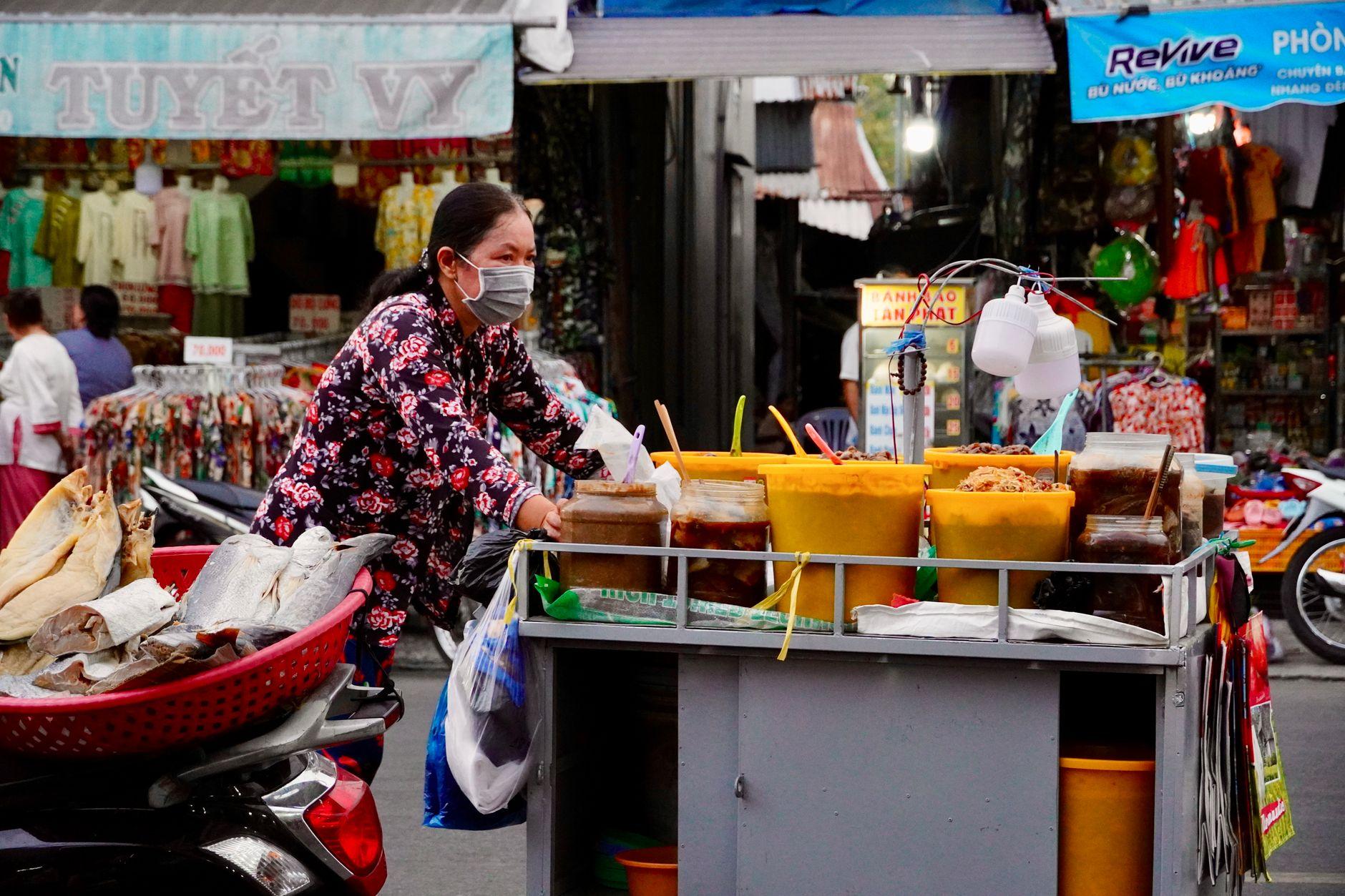
Vietnam is one of the cheapest places in the world to travel and one of the easiest places to quietly lose money without noticing. The prices have a confusing number of zeros, two of the most common banknotes are nearly the same shade of blue, your credit card works in fewer places than you expect, and the locals around you are paying with QR codes you seemingly can't use. Here are the questions travelers actually ask about paying in Vietnam, answered straight.
Why did I just pay ten times too much for a coffee?
Because of the zeros, and because of the colors. Prices in Vietnam run into the tens and hundreds of thousands of dong, so a menu might say 45 and mean 45,000. Most travelers adjust to that within a day. The sneakier trap is the banknotes themselves: the 20,000 dong note and the 500,000 dong note are both blue polymer, and in a dim restaurant or a hurry at a taxi window they are easy to confuse. Handing over a 500,000 note when you meant to hand over 20,000 is probably the single most common money mistake tourists make in Vietnam. Most vendors will correct you. Not all will.
The fix is boring but effective: sort your notes by denomination before you go out, and double check any blue note before it leaves your hand. Or sidestep the problem entirely by paying with your phone, where the amount is typed in digits and you review it before confirming.
Is Vietnam cash only, or can I actually pay with my phone?
Vietnam has quietly become one of the most QR-friendly countries in Asia. The national standard is VietQR, and it is everywhere: laminated QR codes taped to the glass at coffee shops, propped against the basket of a street vendor's bicycle, printed on a card next to the till at pho joints. Locals scan with their bank's app, the money transfers instantly, and nobody fumbles with change.
Cash is still very much alive, especially in rural areas, wet markets, and with older vendors, so you shouldn't land with zero dong. But in Hanoi, Ho Chi Minh City, Da Nang, and most tourist towns, you can genuinely go days paying by QR for coffee, meals, motorbike repairs, and market snacks.
Can a tourist use VietQR without a Vietnamese bank account?
Not directly. VietQR payments normally run through a Vietnamese bank app, and opening a local account as a short-term visitor is somewhere between difficult and impossible. This is the frustrating part for most travelers: the QR code is right there, the vendor is pointing at it, and your phone can't do anything with it.
This is exactly the gap Moreta Pay fills. You top up a wallet from your home bank or an international card in your own currency, then scan the same VietQR codes locals use. Before you confirm, you see the amount, the merchant name, and the exact exchange rate, then the vendor is paid instantly in dong. No local account, no cash counting, no squinting at blue notes. If you're curious how Vietnam compares to its neighbors on this, we've looked at how open each country's QR network is to foreign visitors across the region.
Why was my credit card declined at a perfectly nice restaurant?
Because outside hotels, shopping malls, and upscale chains, foreign card acceptance in Vietnam is patchy. Plenty of good restaurants, tour offices, and homestays simply don't have a card terminal, or they have one that only likes local cards. Some that do accept foreign cards add a surcharge or ask for a minimum spend. It isn't personal, and it isn't about your bank. Card infrastructure for international networks just never spread far beyond the tourist-facing top tier here, because locals leapfrogged straight to bank transfers and QR.
Assume your card works at your hotel and the mall, and plan to pay everywhere else with cash or QR.
Where should I get dong: the airport, an ATM, or a money changer?
Airport exchange counters are convenient and usually give you a worse deal, so change only what you need for the first day if you change anything at all. ATMs are plentiful in cities, but many charge their own operator fee on top of whatever your home bank charges, and per-withdrawal limits at some machines can force you into several fee-laden withdrawals to get a useful amount. We broke down ATM operator fees across Southeast Asia if you want the full picture before you fly.
In practice, the cheapest approach for most travelers in 2026 is a hybrid: keep a modest amount of cash for markets and rural stops, and pay by QR for everything else so you're not feeding ATMs all trip.
The terminal asked if I want to pay in dollars. Should I say yes?
No. Always choose dong. When a card machine or an online checkout offers to charge you in your home currency, that's dynamic currency conversion, and the rate baked into it is almost always worse than what your card or wallet would give you. It feels helpful because the number looks familiar. It isn't helpful. Pick the local currency every time, in Vietnam and everywhere else.
How do I pay for hotels, buses, and online bookings inside Vietnam?
Big platforms like Agoda and Trip.com take international cards for hotels and transport, so those bookings are usually painless. Where travelers get stuck is local checkouts that only offer bank transfer or QR payment, which is common for domestic services, Shopee orders, and some tour operators. Since Moreta Pay also handles QR-based online payments, you can get through those checkouts the same way you'd pay a street vendor: scan, check the rate, confirm. For intercity buses and smaller tour offices, expect cash or QR rather than cards.
What do I do with leftover dong when I leave?
Ideally, don't have much. Dong is hard to exchange outside Vietnam, and converting it twice (your currency into dong, then dong back into something else) means paying the spread in both directions. We've written before about how double conversion quietly costs travelers twice, and dong is one of the clearest examples. Spend your remaining notes on your last days, use QR for anything beyond what's in your pocket, and you'll leave the country with nothing stranded in a drawer at home.
So what's the smart setup before I land in Vietnam?
Carry some cash for the places that still want it, refuse dollar pricing at terminals, triple check blue banknotes, and get yourself onto the QR rails everyone around you is using. Load a Moreta Pay wallet from your home bank before your flight, and that laminated VietQR code at the egg coffee shop stops being a locals-only club. Set up Moreta Pay before you board and your first bowl of pho can be a scan instead of a math problem.