
Bolivia confuses first-time visitors more than almost any country in South America when it comes to money. In La Paz you'll watch a cafe customer pay for a salteña by pointing a phone at a laminated square on the counter. Three hours away in a smaller town, the only thing anyone accepts is a crisp boliviano note, and preferably not a big one. Both of those Bolivias are real, and you need a plan for each. Here are the questions travelers, remote workers, and new expats actually ask, answered without the fluff.
What is QR Simple, and why does it matter to me?
QR Simple is Bolivia's interoperable QR payment standard. In plain terms, it means the QR sticker at a coffee shop in Sopocachi or a pharmacy in Equipetrol works across participating banks and wallets, rather than being locked to one company's app. It's the same idea behind Pix in Brazil or PromptPay in Thailand: one code on the counter, many apps that can read it. For a visitor, the significance is simple. If you can scan that code, you can pay the way locals in the big cities increasingly do, without a Bolivian bank account and without hunting for exact change.
Where in Bolivia will QR actually work?
Think of it as a two-tier map. La Paz and Santa Cruz are where QR Simple adoption is genuinely growing: cafes, restaurants, pharmacies, supermarkets, mall shops, and a surprising number of market stalls display codes. Cochabamba sits somewhere in between. Once you leave the major cities, Bolivia becomes firmly cash territory. In Uyuni before a salt flats tour, in Rurrenabaque heading into the Amazon, in small Altiplano towns on the way to Sajama, assume you'll be paying in physical bolivianos for nearly everything, from your hostel bed to your trucha dinner on the shore of Lake Titicaca.
Do I need a Bolivian bank account or local SIM to scan these codes?
You don't need a Bolivian bank account, and that's the part most guides get wrong. Local banking apps generally require local accounts and local ID, which rules visitors out. What you need instead is a wallet built for exactly this gap. Moreta Pay lets you top up in your own currency from your home bank or an international card, then scan the same QR Simple codes locals use. Before you confirm, you see the amount in bolivianos, the exchange rate applied, and the merchant's name on your screen. The merchant gets paid instantly in local currency, and you never opened an account in Bolivia. A data connection helps, so an eSIM or local SIM is worth having, but the bank account problem disappears.
How does paying by QR actually go at the counter?
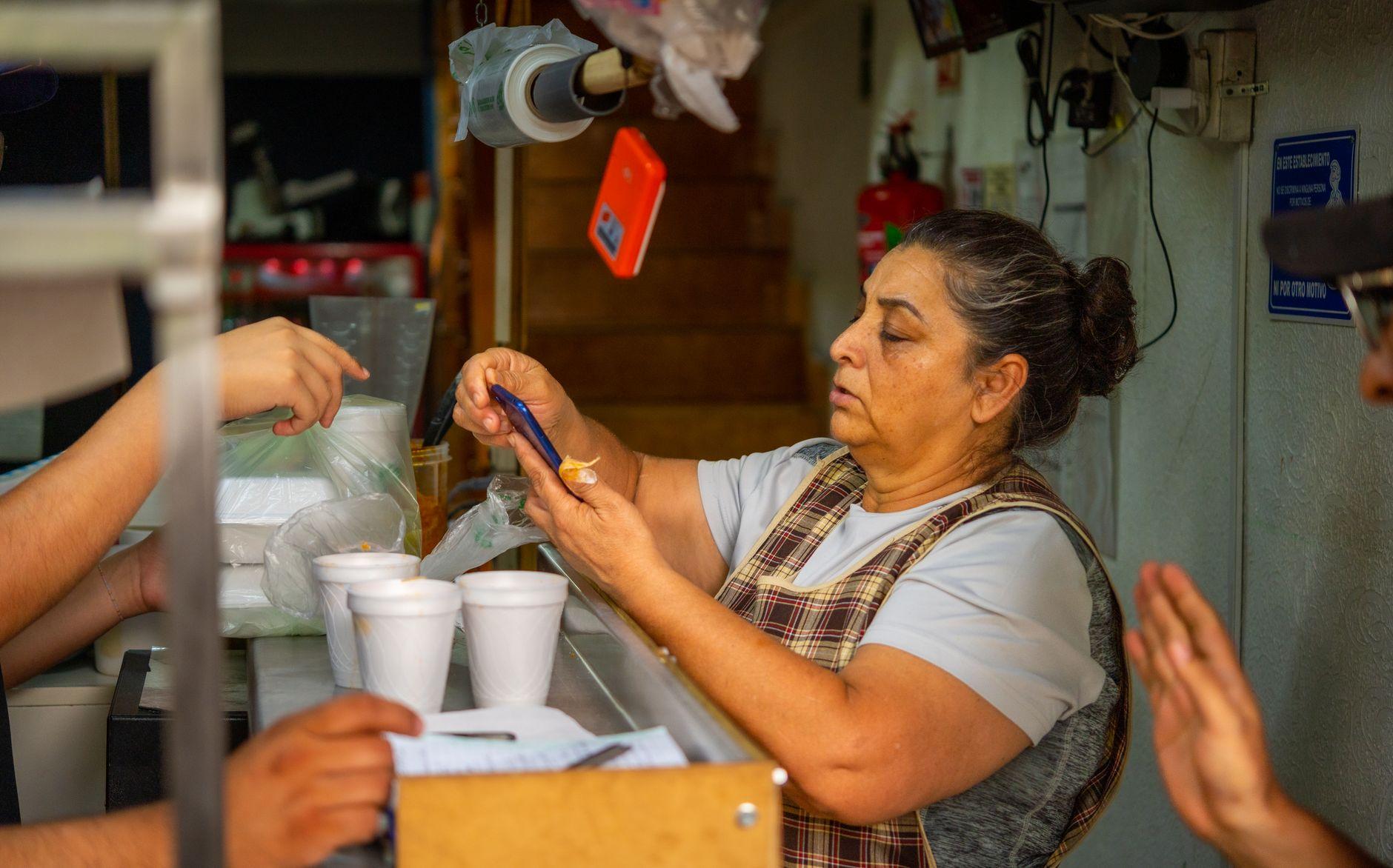
Slower to describe than to do. The cashier either points at a printed code taped near the register or shows one on a small screen. You scan it, type or verify the amount, glance at the merchant name to confirm you're paying the right stall (useful in crowded markets where codes sit close together), and tap confirm. The vendor usually gets a notification or checks their own phone for the confirmation. In La Paz this whole exchange takes less time than waiting for change from a 100 boliviano note, which, incidentally, many small vendors will grumble about breaking anyway.
Should I still carry cash, and how much?
Yes, absolutely. Bolivia is not a leave-your-wallet-at-home country and won't be for a while. Cash is essential for minibuses and trufis, small comedores, rural anything, tips for guides, and entry fees at smaller attractions. A sensible rhythm for most visitors: pay by QR wherever a code is displayed in the cities, and keep a cushion of small-denomination bolivianos for everything else. The goal isn't zero cash. The goal is withdrawing far less of it, far less often, which matters more in Bolivia than almost anywhere because of the next question.
What's the deal with ATMs outside the big cities?
This catches people constantly. Outside La Paz, Santa Cruz, and Cochabamba, ATMs that accept foreign cards are scarce, and even where a machine exists it may be empty, offline, or unwilling to talk to your card. Travelers headed to Uyuni or the jungle towns routinely discover this the hard way. The practical rule: withdraw what you'll need for a rural stretch before you leave a major city, and use QR in the cities to stretch that cash further. We went deep on the withdrawal math in our earlier piece on avoiding ATM pain in Bolivia, so if fees and machine-hunting are your main worry, start there.
Can I just pay with US dollars or my credit card instead?
Dollars are useful for some tour operators and higher-end hotels, but day-to-day commerce runs in bolivianos, and you'll rarely get a favorable deal paying in USD at a shop. Card terminals exist at upscale restaurants, chain supermarkets, and hotels in the big cities, but they thin out fast, and plenty of mid-range places that happily display a QR code have no card machine at all. In practice, the local hierarchy in La Paz and Santa Cruz is QR first, cash second, card a distant third. Adjusting to that order will save you awkward moments.
Will taxis and market vendors take QR?
Increasingly, yes, in the cities. Ride-hailing drivers in La Paz and Santa Cruz often accept QR, and a growing share of stall owners in markets like Mercado Rodríguez or Los Pozos keep a code handy, sometimes a printout tucked under the produce scale. Street taxis flagged on the road are more of a cash affair, and rural transport is cash only. When in doubt, ask "¿Aceptas QR?" before you order or get in. Bolivians ask each other the same thing, so nobody will find the question strange.
What about booking things online or paying a bill?
If you're staying long enough to have recurring costs, QR helps there too. Many Bolivian services and platforms present a QR code at online checkout rather than a card form, and expats often find their coworking space, gym, or internet provider prefers a scanned payment over anything involving a foreign card. Moreta Pay handles QR-based online checkouts and bill payments in supported countries the same way it handles a counter payment: scan, review the rate and amount, confirm. For digital nomads settling into Sopocachi or Equipetrol for a season, that covers most of the monthly admin.
How does Bolivia compare to its neighbors?
If you're on a longer South American route, calibrate your expectations by country. Brazil is far ahead, with QR nearly universal. Peru sits in the middle, with its own QR habits worth learning before Cusco. Bolivia is earlier in the curve, which means the payoff for using QR is concentrated in the cities but very real there, especially given how hostile the ATM situation is everywhere else. Treat La Paz and Santa Cruz as your QR zones and your cash resupply points, and the rest of the country becomes much easier to budget for.
One thing to sort out before you land
Everything above works better if your wallet is funded before wheels-down in El Alto, since airport Wi-Fi and a fresh SIM are a shaky foundation for setting up payments on the spot. Load up Moreta Pay from your home bank while you're still somewhere with good internet, and your first Bolivian purchase can be a scan instead of an anxious currency exchange line. You can get your wallet ready in a few minutes here, then spend your first afternoon in La Paz looking at the city instead of looking for a working ATM.